We have our monthly come-as-you-can collegial community meeting hosted by Kari Kurto from The Reading League, Claude Goldenberg and Jana Echevarria facilitate discussions. Our zoom meetings take place on the first Friday of each month.
Last month, the group engaged in a lively discussion of research shared by Elsa Carenas-Hagan and Sylvia Linan Thompson. There was so much to discuss that we are thrilled to say that we will be welcoming them back March 29th at 12:30pm PST / 3:30pm EST.
This is a reminder that this group will meet this Friday, March 29 at 12:30 PST/3:30 EST for another lively discussion.
For those of you interested in attending, whatever your perspective, please complete the form and share with interested friends and colleagues.
With more than 5 million multilingual learners in our schools, many teachers wonder how these students can be taught grade-level content in a way that makes the content understandable for them. Yes, teachers want to provide effective instruction for multilingual learners, but some teachers may not be aware that multilingual learners are legally entitled to the same educational opportunities as English proficient students, including access to grade-level curricula. All students, multilingual learners and English speakers alike, should be learning the same content. The idea that multilingual learners aren’t ready for grade-level material simply isn’t supported by research. In fact, literacy research tells us that students learn better with challenging text. However, it is essential that multilingual learners are provided with scaffolding and supports that allow them to access challenging texts and materials.
The following are three ways to help multilingual learners access grade-level content.
1. Be clear. This may seem like a no-brainer but expressing oneself in a way that is easily understood is more challenging than it may seem. Remember that grade-level content contains vocabulary and language forms that likely will be difficult for multilingual learners to follow. While clear, concise speech is critical for multilingual learners, it is good for all. Think of TEDTalk speakers, newscasters and other professional speakers. They speak clearly, enunciate, and limit the amount of information they give to listeners. Typically, they pause a bit between chunks of words to let listeners process their message. Make sure your presentation of information and especially instructions for completing tasks are well-described, clear and unambiguous. Also consider posting a completed assignment for students to refer to in case they don’t understand all the language used in your instructions.
Another way to make sure your message is clear is through modeling and repetition. Multilingual learners may become frustrated or disengage from learning if they can’t follow your instructions or can’t understand the presentation of content. I learned the value of modeling and repetition when I attempted to learn to play the guitar from internet instruction. The videos were easy to follow because the instructor 1) demonstrated what he was talking about; 2) repeated the message several times in slightly different ways; and 3) asked me to practice each step after teaching something. While I couldn’t ask the instructor questions, I could replay the videos and catch what I missed the first time (repetition).
2. Explicitly teach vocabulary. Teachers select a set of academic vocabulary words and teach those words across several days with opportunities to practice using the words in a variety of instructional activities. Visuals, student-friendly definitions, and opportunities to use the words orally with peers are but a few ways to make the words meaningful for multilingual learners and “stick” so that the words become part of their own vocabularies.
Criteria for selecting words to teach include:
Words necessary for understanding the text. Often referred to as key vocabulary, these words may be bolded in the text but there are most likely other words whose meaning is necessary for multilingual learners to understand the text.
Words frequently used in the text. Teaching words that students will encounter numerous times provides them with multiple opportunities to see how those words are used in text.
General academic words that likely appear in other content area texts. Word lists may be consulted for selecting cross-curricular academic terms that students will be exposed to across subject areas.
Words with multiple meanings. Students will encounter certain words across disciplines with different meanings, e.g., the meaning of pound as a unit of weight in math differs from its meaning, to hit, in English language arts. Explicitly teaching the definitions of these words allows students to understand how words function in different contexts.
Words with affixes. Many words are comprised of root words and affixes. For example, view changes meaning when the prefix re– is added to make review. Teaching word parts gives students more bang for the buck. As they begin to understand the meaning of common prefixes such as un-, dis– and mis– and suffixes such as –ism, –ist, and –cy and learn how those word parts alter the meaning of words, their vocabulary expands exponentially. Knowledge of word parts facilitates analysis of the meaning of unknown words.
Cognates. Teaching words that have relationships across languages such as conclusion (English) and conclusión(Spanish) helps students see that new words are related to those from their home language.
There are lots of free and inexpensive vocabulary apps available so that students can practice new words, for instance, during free time, center time, and at home. Most apps provide a word’s pronunciation, its definition, translation, and a visual of the word. Many vocabulary apps work on phones as well as tablets.
3. Provide supports for reading text. Grade-level texts are typically challenging for multilingual learners so scaffolds for reading text are essential. Here are some ways to provide access for multilingual learners:
Audio books. Students listen to a text being read while they read along. Many commercial reading programs offer audio books, and there are numerous sites that offer free audio books to students.
Teacher read-aloud. To be most effective, teachers pause after reading a portion of text, ask questions, make connections between the text and students’ experiences, and highlight key vocabulary. Comprehension is enhanced when teachers jot illustrations or use graphics to help multilingual learners understand and remember words and concepts.
Partner reading. Younger partners typically can read together and gain practice reading text. With older students consider Read Aloud, Think and Summarize. In this process, each student reads a paragraph and summarizes it. For example, Partner A reads and orally summarizes while Partner B listens and asks clarification questions. Then partner B reads and summarizes. This technique is effective because students collaboratively figure out the meaning of the text through discussion.
SQP2RS is a process for reading expository text that has been shown to improve reading comprehension. The steps are as follows:
Survey: Students individually preview and scan the text to be read for about one minute to determine key concepts that will be learned.
Question: In groups, students generate questions likely to be answered by reading the text.
Predict: Students come up with three or four key concepts they predict they’ll learn while reading.
Read: While reading, students mark answers to their generated questions using sticky notes or highlighters.
Respond: Students discuss and answer the questions generated by the class.
Summarize: Orally or in writing, students summarize the text’s key concepts.
The SIOP website offers free downloadable posters that outline each step of SQP2RS. The posters are useful for teaching SQP2RS as well as for student reference as they begin to use the process independently.
The ideas presented here are intended to facilitate using grade-level content with multilingual learners in your classes. Hopefully, you’ll find the ideas useful.
(A version of this blog was posted on May 25, 2020)
During the meeting on February 23, Dr. Elsa Cardenas-Hagan and Dr. Sylvia Linan-Thompson will be discussing their research on interventions for MLLs having difficulty in early reading in Spanish and in English. Of interest is that even students receiving native language literacy instruction can have difficulties. These studies look at how these students can be helped to get on track.
The debate about how to best teach reading is not new but it has gained steam in recent years when journalists and parents entered the discussion which caught the attention of the public, policy makers, and other interested groups.
Regarding literacy and multilingual students, there are at least two issues that merit attention. One is that these students, although the fastest-growing population in our schools comprising over 5 million students, are woefully absent from many of the conversations about literacy regarding the science of reading. Secondly, there have been divergent viewpoints between researchers and advocates in the science of reading field and some researchers and advocates who support multilingual students.
As I’ve written about previously, science of reading folks assert that we should focus on foundational reading skills like phonemic awareness, phonics and decoding, but also understand that language and knowledge must be developed and should include activities such as hearing stories and expository texts read aloud to get rich language and content exposure. It’s not all about decoding; it’s about building comprehension and important literacy skills such as fluency, vocabulary, and oral language.
Some of those who advocate for multilingual learners, on the other hand, promote “balanced literacy” which focuses on understanding the meaning of what you’re reading right from the start. Balanced literacy folks are not opposed to phonics teaching, but sounding out written words is considered only one way to recognize words. Students can also use pictures and other clues to guess at what the word is or what the sentence means.
The common goal shared by all stakeholders is to strive for proficient reading and writing skills for every student. It is critical that these same stakeholders provide accurate information to practitioners, a message that is evidence-based and promotes instruction that addresses not only phonics but also the components of language comprehension, writing, oral language development, word recognition, and, for multilingual learners, English language development.
To that end, there is a growing number of educators who are focused on finding common ground as we move forward and continue working on deepening and expanding our knowledge about literacy issues, particularly as they relate to multilingual learners.
In 2022, The Reading League initiated conversations between experts on both sides of the literacy debate. The group discussed critical points of contention, “aiming to listen, learn, and build trust.” The group acknowledged that “proponents of the science of reading sometimes don’t intentionally emphasize supporting the language needs of ELs/EBs. They also worked to dispel myths, challenging misconceptions about the science of reading as a one-size-fits-all approach, a specific instructional program, phonics-only, or any misinformed beliefs that misrepresent what the science of reading truly is—a body of knowledge derived from decades of scientifically-based reading research.”
The efforts to build consensus between science of reading experts and experts who support multilingual learners led to a one-day Summit in March 2023 where a variety of viewpoints were represented.
In April 2024, The Reading League will host a second summit in San Diego, CA, Finding the Alignment: From Research to Practice. As stated on the website, the Summit will continue the conversation from last year where “voices from the field of reading science united with those from the English learner/emergent bilingual community.” The impressive list of topics and panelists is found on the website.
If you don’t have multilingual learners in your class today, you will shortly. “Teachers of multilingual learners” means essentially every educator in America since multilingual learners are the fastest growing student population comprising approximately 10% of students nationwide with much greater percentages represented in urban areas and elementary grades. In many areas of the U.S., the numbers of multilingual students continue to grow, and other geographic areas and grade levels will undoubtedly experience an influx of multilingual students in the near future. The resources we offer are designed to make a positive impact on the lives of our multilingual learners — and their teachers — by providing tools for making grade-level lessons understandable for students and empowering teachers to meet the educational and linguistic needs of all students.
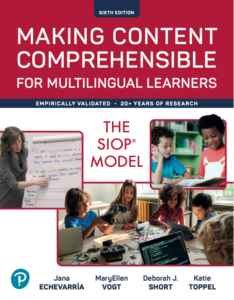
We’re delighted to announce that a new edition of Making Content Comprehensible for Multilingual Learners: The SIOP Model was published in 2023. What educators know about effective instruction continues to evolve as we learn more from research and practice. Over the past decade, understanding of effective sheltered instruction and the needs of multilingual learners has grown substantially. As a result, there are new trends in teaching multilingual learners which are included in the book, highlighted below.
Perhaps most notable is that we have added a new author to our SIOP team, Dr. Katie Toppel, who brings a wealth of experience, creativity, and knowledge to the team. (And fun!) Based on her experience as a SIOP teacher and a SIOP author she says about the SIOP Model: “It’s powerful and it’s meaningful and it works.” Her passion for multilingual learners is undeniable and she made the following comment about the SIOP author team: “We care so much about the teachers, and we care so much about the children.” Indeed, that is what keeps all of us active in the education of multilingual learners.
Click here to watch a short video of the authors discussing our latest work.
We hope that you’ll use this new book as a guide for lesson planning and teaching in K-12 general education classes as well as in ELD classes and special education classes. Effective instruction crosses the artificial categories we create in education. All students benefit from teaching that meets their individual needs.
Although the format is the same as previous editions, approximately 50% of the content is revised or new.
Asset orientation. Since the creation of SIOP, we have consistently adhered to an asset orientation, but you will find it more prominently presented in this edition. We emphasize that multilingual learners bring cultural, linguistic, and experiential assets to the classroom and give concrete examples of how teachers can and must acknowledge those assets and build upon them instructionally. Another way we emphasize an asset orientation is a change of the book’s title. We have previously used the term, English Learners, but Multilingual Learners more accurately captures the linguistic abilities of these students. Oh, that we all were multilingual!
Use of the home language. There is growing understanding that students benefit from using their full linguistic repertoire in two or more languages purposefully to accomplish a task. Translanguaging in a SIOP classroom is a pedagogical practice that encourages students to use and apply the knowledge they have gained through any language medium (e.g., meaning of words in their home language) to make meaning and perform instructional activities. You’ll find more explicit attention in chapters as to how teachers can use translanguaging practices and build upon students’ home languages and other assets. Further, SIOP Feature 19 has been slightly reworded to make it clear that using the home language in class strategically can help students acquire English and deepen their content knowledge.
New chapter, Collaborative Practices for Implementing the SIOP Model. Collaboration between ELD/ESL specialists and general education teachers is essential for providing coherent, effective services for multilingual learners. Co-teaching is most effective so that both teachers support one another. This important new chapter provides a detailed explanation of how to implement the co-teaching process effectively. Included are profiles of a general education teacher and ELD/ESL specialist to illustrate the co-teaching process. ELD/ESL specialists and general education teachers will find the content of this chapter to be an invaluable guide for effective collaboration.
New chapter on Multi-Tiered System of Supports for Multilingual Students (MTSS). Many educators are concerned about multilingual learners who exhibit reading or learning problems and are struggling academically because of them. Few books about teaching multilingual learners address the topic of using data-driven supports to improve students’ academic performance. We provide an illustrated step-by-step process to help educators navigate MTSS with attention to the special considerations needed with multilingual learners. The chapter also includes three case studies of struggling multilingual learners and demonstrates how these students move through the process.
Focus on technology. During remote learning, teachers found the use of technology to be essential for teaching. Competence in technology went from a skill that was nice to have to one that was a must-have. Accordingly, we’ve integrated technology throughout the chapters to reflect the competence teachers have developed in embedding technology in their lessons. We’ve also added more ideas for using technology for remote learning, which remains a reality for some teachers.
Teaching ideas. Teachers enjoy learning a new activity or teaching idea to use with their students that reinforces their explicit teaching. You’ll find innumerable fresh, new, use-tomorrow ideas and activities throughout the chapters.
Research. Research studies and syntheses conducted in the past decade are included throughout the book to ensure that multilingual students are receiving instruction that is grounded in proven, tested practices. In sections that address literacy and multilingual learners, studies from the body of research known as the science of reading (SOR) are included.
Additional resources. There are links to new videos, revised teaching scenarios for practice in analyzing and rating lessons, revised discussion questions and application exercises for use in teacher preparation classes or professional learning networks (PLNs), an updated list of resources for further information, including books, journal articles, book chapters, and downloadable research briefs.
Professional Learning. There are links to blogs and a link for information about SIOP professional development, http://siop .savvas.com. You’ll find a variety of professional learning opportunities offered by Savvas.
We are gratified that for more than 20 years SIOP has provided a resource that, simply put, helps teachers help kids.
With SIOP now being used in dozens of countries, and with over50 peer-reviewed published research studiesdemonstrating its effectiveness, we hope that the new edition of our book and other resources we offer will continue to positively impact the education of multilingual learners.
(A different version of this blog was posted in May 2023, prior to the video being available.)
A long-held belief by some about language and literacy development for multilingual learners is that they learn each domain in a somewhat sequential manner: listening comprehension is followed by speaking, then students are ready to read and finally write.
We need to dispense with this notion.
While it is true that multilingual learners need to develop oral language to improve their comprehension of reading and their ability to write – one cannot understand or use words that have no meaning – we certainly do not have to wait until multilingual learners reach a certain level of oral English proficiency to teach reading and writing. In fact, the integration of reading and writing is instrumental in fostering a holistic language learning experience, enhancing language proficiency, and facilitating meaningful communication.
In a blog on the topic, literacy expert Tim Shanahan discusses research demonstrating that writing about reading improves comprehension and learning more than reading alone, rereading, and reading and discussing.
There are other benefits specifically for multilingual learners with respect to the interplay between reading and writing. Some include:
Enhanced Language Proficiency
One of the primary advantages of teaching reading and writing concurrently is the development of comprehensive language skills. English learners benefit from the exposure to written language structures, vocabulary, and discourse patterns while reading. They can then apply this knowledge to their writing, creating meaningful and grammatically sound texts. By actively using and producing language in both forms, learners enhance their overall language proficiency.
2. Improved Comprehension and Expression
The reciprocal relationship between reading and writing allows learners to deepen their comprehension skills while also honing their ability to express themselves effectively. When students read, they learn to decode and understand texts, while writing enables them to encode their thoughts and ideas into written form. These processes reinforce each other, fostering a deeper understanding of language and the ability to communicate fluently – a goal for all students.
3. Contextualized Learning
Simultaneous teaching of reading and writing provides a contextualized learning experience for multilingual learners. Rather than isolating these skills, which can lead to fragmented language learning, this approach immerses students in authentic language contexts. Learners encounter real-world language use in reading materials and have the opportunity to create their own texts, mimicking the communicative situations they will encounter in everyday life.
3. Increased Motivation
Engaging learners in reading and writing activities simultaneously may boost their motivation (see examples below). Reading provides learners with exposure to a wide range of texts, allowing them to explore different genres, topics, and writing styles. When students can respond to these texts through writing, they have a more personal and creative outlet for expression, which can be highly motivating.
4. Skill Transfer
Teaching reading and writing together encourages the transfer of skills and strategies between these two domains. For instance, when students analyze the structure of a text they are reading, they can apply the same analytical skills to their own writing. This transfer of skills enables learners to become more versatile and adaptable in their language use.
One of our favorite ideas for integrating reading with writing, as well as speaking and listening, is called SQP2RS or “Squeepers” (Video explanation is found here). It is most effective with expository text, which is often the most challenging for multilingual learners. Students survey a piece of text for just one minute and, in partners or small groups, then write questions they think will be answered by reading the text. Next, students make predictions based on the questions they generated. Then the text is read and afterward students engage in the respond stage where they work together to decide whether their predictions were confirmed or disconfirmed. At this point, students will be able to write a summary of the text, including the key content topics that were discussed.
Here are a few additional ideas for integrating reading and writing:
Fiction
Use stories to integrate tasks that require students to read a text and then respond in writing. For example, after reading a short story, have students write a summary, a personal response, and alternative ending, or a creative continuation of the story.
Journaling
Encourage students to maintain reading and writing journals. In their journals, they can record their reactions to texts they read, summarize key points, compare/contrast events to their own lived experiences, or write reflections on their reading experiences. This practice helps learners make connections between their reading and writing activities and is naturally differentiated since it is done at their level of language proficiency.
Peer Feedback
Capitalize on peer collaboration by implementing peer review and feedback sessions in which students read and provide constructive comments on each other’s writing. Peers might ask questions that help the writer fill in gaps in their written product. This process not only enhances writing skills but also fosters reading skills, as students critically analyze their peers’ texts.
Writing Prompts
Provide writing prompts that are directly related to reading materials. For instance, ask students to write a letter from the perspective of a character in a story they read or to create a diary entry for a historical figure they encountered in their reading. Writing prompts have been popular for ages but it’s important to link the prompt to the reading for maximum learning.
Finally, the following is a powerful example of the capabilities of multilingual learners when reading and writing activities are intertwined, when teachers have high expectations and use instructional practices that make content understandable and support students’ academic progress.
Award-winning teacher, Emily Francis , author of the book, If You Only Knew, teaches high school newcomer students who have been in the United States for less than one year. From her extensive experience working with multilingual students she says:
I refuse to believe that “writing domain” is “the last to develop” for MLs. With a comfortable environment, scaffoldings, comprehensive input, compelling text, interaction with the text, discussions, intentional support, groups, repetition, and teacher feedback…they CAN write!
Here are some impressive examples of her students’ writing.
Teaching reading and writing together with multilingual learners is an approach that is rooted in research, offering numerous benefits for language acquisition. It promotes comprehensive language skills and, importantly, empowers learners to comprehend and express themselves effectively as demonstrated by Emily’s newcomer students.
The “Reading Wars” have been around for decades – the debate about how best to teach kids to read. If you’re not quite sure what all the current fuss is about, essentially the two sides are: 1) those who say we should focus on foundational reading skills (we’ll call them the Science of Reading or SOR folks) and 2) those who subscribe to the whole language or balanced literacy approach. Unfortunately, some take the “you’re either with us or against us” stance which doesn’t do teachers any favors.
Balanced literacy is about understanding the meaning of what you’re reading right from the start. Balanced literacy folks are not opposed to phonics teaching, but sounding out written words is considered only one way to recognize words. Students can also use pictures and other clues to guess at what the word is or what the sentence means.
On the flip side, the SOR folks emphasize teaching the basics, like phonics and decoding. But they also believe that kids should hear stories read aloud, especially ones they can’t read on their own yet, to get rich language exposure. It’s not all about decoding; it’s about building comprehension and important literacy skills such as fluency, vocabulary, and oral language.
SOR, which might simply be called research on reading, refers to studies conducted and published over several decades in the U.S. and around the world in multiple languages. These studies conclude, among other findings, that phonics is essential for becoming a skilled reader. Even those students with robust vocabularies and background knowledge need to be taught how to read the words on the page.
Sure, some people on both sides seem to act like they’re worlds apart when it comes to teaching reading. But let’s take a step back, as Jim Cummins reminds us, “There is a huge amount of agreement when we get away from the political dimensions of how to teach reading effectively….Everybody agrees that students need phonemic awareness, they need to have a strong foundational basis in understanding sound symbol relationships, phonics.” (2022).
Amanda Goodwin, who worked with both camps while co-editing a series on literacy for Reading Research Quarterly, summed it up well: “Overall, I’d say that the experts agreed … not to insist that there’s a single, ‘one best’ way to teach reading” (Heller, 2022).
Teachers often get caught between policies, personal preferences, and extreme philosophies. Both sides have their points. Phonics is crucial, no doubt about that. But reading isn’t just cracking the code; it’s also about making sense of what you read. It’s like putting together a jigsaw puzzle. You need both pieces—the code (letters and sounds) and the meaning (what it all adds up to). An excellent resource for teachers – and parents, administrators, and policymakers — called 10 Maxims, illustrates that integration of these processes is the key. The focus of our attention should be on finding common ground as we move forward and continue working on deepening and expanding our knowledge literacy issues.
Let’s face it, teachers are swamped. Who has time to dive into all that literacy research? In a nutshell, teaching phonics is essential but it shouldn’t be the first and only skill to be taught. It should be part of a language-rich program with read alouds, discussions, vocabulary development and the like. Some specific points for teachers to keep in mind include:
Decoding is essential but other context clues can help students confirm the meaning of the words students sound out.
Although phonics isn’t the only aspect of reading that makes a skilled reader, it is the bedrock of reading and literacy more generally.
Detailed discussions of segments of text help students develop vocabulary and better understand the full text.
Predictions related to a text’s meaning help students engage in and comprehend what they read, particularly when the teacher revisits predictions and confirms or refutes them based on evidence in the text.
Explicitly teaching key vocabulary prior to reading and pointing out the words when they are encountered in the text help build vocabulary and comprehension.
Reading a variety of texts is important: fiction, poetry, nonfiction (e.g., biographies) and informational from social studies and science.
The practice of integrating discussion with reading and writing is beneficial for skill building. Talk about the text (predictions), read about it, talk about what was read, write about it (e.g., a summary, a graphic organizer, or an opinion piece), then talk about what was written.
Multilingual learners also need to learn decoding and foundational skills. Teachers need to provide English oral language instruction so that students understand the words being used to teach foundational skills. Teachers should also provide kids with plenty of chances to use the language with their peers. For example, explicitly teach vocabulary terms or a language form, then have students practice using the language with peers. Since students are learning these new skills and information in a new language, teachers also need to make adjustments to instruction and provide scaffolds to help multilingual learners make sense of what they are reading and hearing. Link here for an excellent discussion of reading and multilingual learners.
In the end, regardless of your personal philosophy or mandate of your school, all kids need both decoding skills and rich language experiences. Explicit skill building activities are essential for becoming fully literate, but alone they won’t achieve the important goal that we all share – to make every student a confident, skilled reader and writer. That’s the real win.
Heller, R. (2022). Taking stock of the science of reading: A conversation with Amanda Goodwin. Phi Delta Kappan, 103(8), 32-36.
A version of this blog appeared in Education Week on September 12, 2023.
The use of social language, the language used in everyday conversations, and academic language, the language of texts and high-level discussions, are often thought of as dichotomous. That is, we think of language use as either one or the other. Actually language use falls along a continuum. In a social situation you may use a lot of conversational language, but the conversation may shift to discussion of issues, or an interesting article recently read. That part of your conversation borders on academic talk, rather than just social talk. Often conversations flow smoothly from serious topics to funny ones, and then back again to something more thoughtful. We are able to use both conversational language or academic language fluidly.
Making students aware that language is used in different ways for different purposes validates the language they already know, and the continuum shows them other language uses that they’re in the process of learning in school.
Standards have focused attention on the need for all students to be able to engage in rich, meaningful discussions, whether orally or in writing. This requires that they have facility with aspects of academic language, such as: comprehend and evaluate complex texts across a range of types and disciplines…construct effective arguments and convey multifaceted information….discern a speaker’s key points, request clarification, and ask relevant questions…build on others’ ideas and articulate their own ideas, and so forth. As educated adults, we are able to move easily across a continuum of language use from conversational to more academic, and then back to conversational.
The following activity teaches students (grades 3 and above) that conversational language and academic language are not opposites. Rather, they exist along a continuum from conversational to academic.
Select three or four students to engage in a social conversation in front of other class members about a familiar topic, such as their favorite video game. After several minutes, debrief the conversation with your class. How did the conversation look and how did it sound? Assist students in recognizing that some students used facial expressions and gestures when communicating; they used words and phrases they all knew; the topic was easy topic to talk about since they had lots of experience with it; and their sentences were primarily simple rather than complex. Jot some of the characteristics on the board.
Strategically select three or four other students to engage in an academic discussion about a topic that they’re currently learning, such as settling the thirteen colonies, making sure the selected students are able to use some key vocabulary during their discussion. You might also provide a list of sentence frames that the students can use when referring to their text for support. Examples include:
The author said….
……… because …………
According to the article (or chapter), ……..
For instance,……..
For example, …….
On page ….., it said, ………
From my reading, I learned ……
As with the social conversation, debrief and list how students characterize the academic language used during the modeling. What kinds of words and sentences did the students use? How was their language different from the first group? Their body language? How did they support their positions with evidence from their reading?
It may be helpful to have the class complete a Venn diagram, comparing and contrasting conversational language and academic language, based on the students’ models, or they can write a few sentences about each type of language use to clarify their understanding.
After students have compared and contrasted conversational language and academic language, create on your white board a continuum, with “Conversational Language” at one end, and “Academic Language” at the other end. Together with your class, fill in the continuum, using students’ examples. For instance, the first spot on the left (currently “Texting family about whereabouts”), could be “Talking about your favorite video game with a friend.” The other end of the continuum (currently “Reading and taking notes…”), could be “Explaining why the thirteen colonies were established with specific examples from our book.”
Here’s what’s important to convey to your students, whether English speakers or multilingual learners: Conversational language is easier to learn because it has lots of clues built in such as facial expressions, simpler sentences, known words and phrases, a familiar topic, and so forth. Academic language is more challenging – and that’s to be expected — because the topic may not be as familiar, the sentences may be more complex, and the vocabulary may be new.
The more academic language students are explicitly taught and provided opportunities to practice, the better they will be able to produce that level of language orally and in writing. This activity teaches students that they need to know both conversational language and academic language to navigate school and careers effectively.
Oral language — the processes involved in speaking, listening, and understanding spoken language — serves as the basis for the development of literacy, which in turn paves the way for academic achievement. Teachers often overlook the need for multilingual learners to practice speaking and to enhance their oral language abilities.
Students acquire basic social language skills through classroom interactions, however their comprehension of English often surpasses their ability to speak as effectively as they would like. Consequently, it’s important for teachers to specifically focus on providing lots of opportunities to develop speaking skills, especially practice using academic language.
However, many multilingual learners are reluctant to speak in class since they may not have the words to express their thoughts completely. They’re aware that they aren’t completely fluent in the language their teacher and peers speak and understand. The following are 5 ways teachers can encourage students to improve speaking skills.
Create the right environment. Few people are willing to speak up or participate in group discussions when they feel anxious or if the setting is intimidating. Establishing a classroom environment where multilingual learners feel respected, welcome, and comfortable when speaking is the first step in building oral language skills. The affective dimension of language learning matters. Multilingual learners take a risk when they use their new language so it’s important for teachers to be accepting of all attempts to express themselves, and correct errors gently and only as a means for avoiding confusion. Another way of creating a stress-free environment is to accept translanguaging as an effective communication strategy. Translanguaging is the process by which multilingual students use two or more languages strategically to accomplish a task. For example, at times multilingual learners are able to express some ideas better in one language or the other and may mix the two languages in a discussion or when completing an assignment with a partner. Allowing students the freedom to use all their language resources encourages oral participation and signals to students that their home language is respected and accepted.
Select interesting topics. If we want students to talk, we need to give them something interesting and relevant to talk about. Teachers can use students’ backgrounds and lived experiences to make connections to nearly any topic. A lot of language can surface in discussions that tap into what students know. For example, when reading about a character in a book or an historical figure, ask: How would you react in that situation? Or What would your family say if you did that? Why? Pictures also can be used effectively to elicit language. For example, show an interesting picture, preferably related to a topic being studied, and ask, What do you think is going on in this picture? What do you see that makes you think that? What else do you see? This process is a less-demanding version of citing text evidence, an important academic skill, and elicits language by having students explain their idea and defend it using the picture.
Form groups intentionally. Opportunities to practice and develop speaking skills need to be planned, intentional and purposeful. Research confirms what most educators know: teachers do more than 80% of the talking in class. Speaking with a partner or small group encourages participation and provides each student with more practice speaking English, expressing themselves, and experimenting with the language.
Sometimes during a lesson teachers realize they have been doing a lot of talking and so suddenly ask the students to turn-and-talk. This haphazard approach is not effective. Whether students turn-and-talk with a partner or participate in a more extended discussion with a small group, interactions should have an academic purpose such as making predictions, summarizing information, discussing an experience they’ve had related to the topic, and so forth. The group interaction should be structured, have an intentional purpose, and be given a reasonable time allotment.
4. Use technology. There are a number of voice and video recording programs available that give students a chance to practice speaking English privately to build oral proficiency. A recording allows students to listen to themselves and identify areas for improvement. Teachers should maintain a digital portfolio so that students can periodically listen to past recordings and hear how they’re speaking improved over time. Teachers have reported that some students barely recognize their own voice on recordings from the beginning of the year to the end, which is gratifying evidence of progress and a real confidence builder.
5. Make it fun. Have students pretend to be a news anchor delivering information, a podcaster who engages in discussion with a guest, a game show host who asks questions of peers, a historical figure who tells about her life and accomplishments, and so forth. The purpose is educational, but the language practice activity is low-stress — and fun!
A colleague who is presenting a session at our upcoming SIOP Virtual Conference requested that I take an opportunity on this blog to publicize the conference and the other resources available to educators of multilingual learners. Great idea!
“Teachers of multilingual learners” means essentially every educator in America since multilingual learners are the fastest growing student population comprising approximately 10% of students nationwide with much greater percentages represented in urban areas. If you don’t have multilingual learners in your class today, you will shortly. In many areas of the U.S., the numbers of multilingual students continue to grow and other areas will experience a new influx of students. The resources we offer are designed to make an impact on the lives of our multilingual learners — and their teachers.
For more than 10 years we have hosted an annual SIOP conference where educators can come together and learn from SIOP colleagues from around the U.S. and internationally. There are many excellent sessions offered to teachers and administrators on a variety of topics pertinent to educating multilingual learners. (See agenda). This year’s theme is, Making an Impact.
Also, we’re delighted to announce that a new edition of Making Content Comprehensible for Multilingual Learners: The SIOP Model is hot off the presses. Why a new edition? What educators know about effective instruction continues to evolve as we learn more from research and practice. Over the past decade, understanding of effective sheltered instruction and the needs of multilingual learners has grown substantially. As a result, there are new trends in teaching multilingual learners which are included in the book, highlighted below.
Perhaps most notable is that we have added a new author to our SIOP team, Dr. Katie Toppel, who brings a wealth of experience, creativity, and knowledge to the team. (And fun!)
We hope that you’ll use this new book as a guide for lesson planning and teaching in general education and ELD classes. SIOP teachers tell us that it’s a resource they turn to again and again as they plan and carry out effective lessons. We encourage you to highlight sections, mark pages with sticky notes, and fill margins with application ideas. There is also an e-book available.
Although the format is the same as previous editions, approximately 50% of the content is revised or new.
What are the most significant changes?
Asset orientation. Since the creation of SIOP, we have consistently adhered to an asset orientation, but you will find it more prominently presented in this edition. We emphasize that multilingual learners bring cultural, linguistic, and experiential assets to the classroom and give concrete examples of how teachers can and must acknowledge those assets and build upon them instructionally. Another way we emphasize an asset orientation is a change of the book’s title. We have previously used the term, English Learners, but Multilingual Learners more accurately captures the linguistic abilities of these students. Oh, that we all were multilingual!
Use of the home language. There is growing understanding that students benefit from using their full linguistic repertoire in two or more languages purposefully to accomplish a task. Translanguaging in a SIOP classroom is a pedagogical practice that encourages students to use and apply the knowledge they have gained through any language medium (e.g., meaning of words in their home language) to make meaning and perform instructional activities. You’ll find more explicit attention in chapters as to how teachers can use translanguaging practices and build upon students’ home languages and other assets. Further, SIOP Feature 19 has been slightly reworded to make it clear that using the home language in class strategically can help students acquire English and deepen their content knowledge.
New chapter, Collaborative Practices for Implementing the SIOP Model. Collaboration between ELD/ESL specialists and general education teachers is essential for providing coherent, effective services for multilingual learners. Co-teaching is most effective so that both teachers support one another. This important new chapter provides a detailed explanation of how to implement the co-teaching process effectively. Included are profiles of a general education teacher and ELD/ESL specialist to illustrate the co-teaching process. ELD/ESL specialists and general education teachers will find the content of this chapter to be an invaluable guide for effective collaboration.
New chapter on Multi-Tiered System of Supports for Multilingual Students (MTSS). Many educators are concerned about multilingual learners who exhibit reading or learning problems and are struggling academically because of them. Few books about teaching multilingual learners address the topic of using data-driven supports to improve students’ academic performance. We provide an illustrated step-by-step process to help educators navigate MTSS with attention to the special considerations needed with multilingual learners. The chapter also includes three case studies of struggling multilingual learners and demonstrates how these students move through the process.
Focus on technology. During remote learning, teachers found the use of technology to be essential for teaching. Competence in technology went from a skill that was nice to have to one that was a must-have. Accordingly, we’ve integrated technology throughout the chapters to reflect the competence teachers have developed in embedding technology in their lessons. We’ve also added more ideas for using technology for remote learning, which remains a reality for some teachers.
Teaching ideas. Teachers enjoy learning a new activity or teaching idea to use with their students that reinforces their explicit teaching. You’ll find innumerable fresh, new, use-tomorrow ideas and activities throughout the chapters.
Research. Research studies and syntheses conducted in the past decade are included throughout the book to ensure that multilingual students are receiving instruction that is grounded in proven, tested practices. In sections that address literacy and multilingual learners, studies from the body of research known as the science of reading (SOR) are included.
Additional resources. There are links to new videos, revised teaching scenarios for practice in analyzing and rating lessons, revised discussion questions and application exercises for use in teacher preparation classes or professional learning networks (PLNs), an updated list of resources for further information, including books, journal articles, book chapters, and downloadable research briefs.
Professional Learning. There are links to blogs and a link for information about SIOP professional development, http://siop .savvas.com. You’ll find a variety of professional learning opportunities offered by Savvas.
We are gratified that for more than 20 years SIOP has provided a resource that, simply put, helps teachers help kids. With SIOP now being used in dozens of countries, and with over 50 peer-reviewed published research studies demonstrating its effectiveness, we hope that the new edition of our book and other resources we offer will continue to positively impact the education of multilingual learners.
See you at the SIOP Virtual Conference! You can register here.
Multilingual students who have been in U.S. schools for 6 or more years and have not yet been reclassified as fluent English proficient are referred to as long-term English learners, or LTELs. There are significant numbers of these students in American schools, and we need to take a serious look at how to best support their academic and linguistic growth.
Too often multilingual learners are passed from class to class, and grade to grade with the assumption that, given time, they will advance in their English language proficiency. However, academic language doesn’t develop simply through exposure to English in school. The best outcomes result from teachers providing consistent instructional supports for making grade-level content comprehensible while at the same time focusing on academic language development.
Apathy can be insidious among long-term English learners. Some students understandably have lost a degree of motivation; they have struggled academically for years. Unfortunately, teachers sometimes also become apathetic about multilingual learners and inadvertently have low expectations for them.
The following are four ways to reduce apathy and to support the needs of long-term English learners.
Practice student agency. Capitalize on the assets and interests students bring to the classroom by providing activities that are meaningful and relevant to them. Allow students to complete assignments through alternative means, driven by their interests, with appropriate guidance from teachers. Student agency gives students voice and often, choice, in how they learn. In so doing, students are empowered to take responsibility for their own learning, which is sure to increase motivation.
Develop a learning profile. Since LTEL students have been in U.S. schools for at least 6 years, they have a foundation of knowledge and skills on which to build. For each LTEL student find out: What are her strengths? Where are there gaps in learning? Which specific literacy skills need targeted instruction? If a student has strong listening and speaking skills, less time needs to be devoted to oral language activities and more time spent on the area that will get them “over the hump” in attaining proficiency. In creating a learning profile, teachers get to know each LTEL student as an individual learner and can better tailor instruction to meet their academic and linguistic needs.
Use proven instructional strategies and techniques. Students who have yet to reach English proficiency likely have not had the benefit of instruction that provides access to the core curriculum and is designed with their linguistic needs in mind. In research with the SIOP Model, multilingual learners whose teachers consistently used proven instructional supports outperformed those students whose teachers were more hit-or-miss in their use of supports. Quality of teaching matters.
Collaborate with colleagues. During grade level planning or in a PLC, the progress of LTELs should be part of the discussion. Share ideas that have worked, offer one another suggestions for helping LTELs access grade-level materials, and discuss ways to integrate language development into content lessons. Creating a community of support with fellow teachers benefits LTEL students and teachers alike. It’s a win-win.