Is SIOP Teaching Culturally Responsive?

The SIOP Model was designed as an approach for lesson planning and delivery of high-quality instruction for English learners. At the time SIOP was developed, teachers of English learners needed guidance on how to incorporate research-based practices into their teaching in a consisteIMG_3430nt and systematic way. They still do.
Because SIOP is an instructional framework, it’s promotion of culturally responsive teaching (CRT) may get overlooked. However, if you compare the tenants of CRT  to the features of SIOP, you’ll see that they intersect quite naturally. Some aspects of CRT are explicit in SIOP’s features and others are implicit. For example, SIOP teaching emphasizes high expectations for English learners by providing multiple ways for EL students to access grade-level content and participate fully in grade-level lessons. While there isn’t a specific SIOP feature, Have high expectations, it is a foundational principle of SIOP teaching. Every child deserves to be equally accepted as a part of her class and/or school, to be equally engaged in its academic and social fabric, to be an equal participant in lessons including having her language and cultural perspectives valued equally.

Let’s take a look at how each SIOP component explicitly promotes CRT:

Lesson Preparation. When English learners develop strong academic skills and content knowledge, they are empowered as individuals. They are better able to advocate for themselves and others and to pursue their dreams. Research confirms that well-planned, focused teaching is effective in promoting learning. As teachers begin to plan a SIOP lesson, they first design content and language objectives which will drive the lesson’s instruction and activities. Posting and reviewing objectives eliminates ambiguity for English learners about the lesson’s purpose and expectations.

During planning teachers ensure that students from diverse cultural and linguistic backgrounds can access grade-level learning by making adjustments based on language proficiency and educational experiences. For instance, leveled reading passages and modified assignments allow all students to learn the same content, but through differentiated texts and tasks. Further, teachers engage students by planning meaningful activities to make the lesson’s content understandable and by choosing materials that are culturally relevant to student backgrounds.

Building Background. SIOP classrooms are student-centered and lessons build on students’ background knowledge and experiences. SIOP teachers capitalize on the funds of knowledge English learners bring to the classroom by integrating students’ realities into lessons. Using students’ own experiences to link to what they are learning not only emphasizes the legitimacy of their cultural heritage but also makes the lesson’s content more meaningful and relevant to them.

Comprehensible Input. SIOP teachers employ techniques such as speaking clearly, using visuals and multimedia, hands-on activities, modeling, and repetition to help students understand instruction at their level of language proficiency, thus providing access to the core curriculum.

Strategies. SIOP teachers recognize that although English learners may not yet be fully proficient in English, they can still think at high levels and respond to higher-order questions. When teachers provide opportunities for English learners to use higher order thinking and encourage them to think critically, not only is it more intellectually stimulating, it conveys high expectations for students. SIOP teachers also use a variety of scaffolding techniques to support students’ understanding of  lessons such as paraphrasing, use of graphic organizers, and showing a model of a completed assignment for reference.

Interaction. One of the best ways to create a caring community of learning is to teach students to interact respectfully and productively with one another. And, of course, provide them with lots of opportunities to do so. Having English learners and English speakers work together in small groups helps create mutual respect among students from different cultures and ethnicities. Developing relationships tends to break down walls and open communication as students learn about and from one another. At other times, English learners may be grouped by language so that they’re able to work together using the same home language. Having students interacting in groups allows the teacher to act as a facilitator, circulating among the groups and listening to students, gaining valuable information about their understanding of the topic as well as their opinions and perspectives. It’s a great opportunity to get to know more about your students in a way that isn’t as likely to occur in whole class teaching. SIOP’s interaction component also encourages ample use of students’ home language which demonstrates respect for students’ linguistic heritage.

Practice & Application. SIOP teachers enable students to practice and apply what they have learned by encouraging them to engage in activities of their choice that reflect their cultural identity. They might create a presentation, design a game, dramatize the topic, write and perform a song, or generate solutions to real-life problems that represent diverse perspectives. While integrating language skills (reading, writing, speaking, listening), these activities also integrate students’  knowledge, experiences, language, and preferences. Activities such as these are an important part of SIOP lessons because they allow students to use their background in a way that enhances learning and at the same time honors their background and heritage.

Lesson Delivery.  As mentioned previously, well-planned, focused teaching is effective in promoting learning. Beyond merely posting content and language objectives, the lesson’s instruction and activities need to support those objectives. Also, in SIOP classes there is a high level of student engagement since SIOP lessons make content comprehensible for students and include activities, supplementary materials, adapted text, and other practices to help students access the same content their English-speaking peers are learning.

Review & Assessment. SIOP teachers consistently check for understanding to ensure that English learners are comprehending the lesson’s content and vocabulary and are participating fully in learning. Formative and summative assessments are multifaceted and take into consideration the various contexts of a student’s life including home, school, culture, home language, and literacy development in both their home language and English. Such assessments provide the most relevant and accurate information for the teacher to use in designing appropriate and culturally relevant instruction.

As you can see, providing high-quality SIOP teaching to English learners in and of itself is culturally responsive.

SIOP teachers have high expectations for English learners, they value students’ linguistic and cultural assets and integrate their language and experiences into lessons. Creating a safe community of learning in which students are encouraged to interact with one another and build relationships is a priority. Through SIOP teaching, students are empowered by their newly acquired knowledge and skills including the ability to think critically about topics and express their thoughts, beliefs, and ideas from their own cultural perspectives.

Based on: Echevarria, J., Vogt, M.E. & Short, D. (2017). Making Content Comprehensible for English Learners: The SIOP® Model, Fifth Edition. Boston: Pearson.
 

Higher Order Questions and English Learners

I’m a huge tennis fan and Rafael Nadal is one of my favorite players. Over the years he has become a fluent English speaker, but I found it interesting that when he was interviewed recently on the television show, 60 Minutes, he opted to use Spanish for the extended on-camera interview because “he expresses himself more freely in Spanish.” That is likely true for many second language learners. A friend made the remark that she feels like her IQ goes up 10 points when she uses her first language. Even when fluent in another language, one’s expression is often affected when using a non-native language.

Screenshot 2020-01-26 14.25.26In the classroom, teachers may underestimate English learners’ capabilities since these students may not be able to adequately express their thoughts, understanding of content, or ask questions in a precise way to get at the information they seek. As a result, teachers may confuse English proficiency with ability. In other words, just because a student can’t speak English fluently doesn’t mean she can’t think – and do so at high levels.


To advance academically and linguistically, English learners need to be sufficiently challenged and one way to do so is by providing ample opportunities to think at higher levels.

Research tells us that about 80% of questions teachers ask are at the literal level. That means students are asked to give back information that was given to them or memorized rather than engaging in critical thinking. Examples of literal or recall questions include:

When did ________ take place? and, What is the definition of __________________.

It’s pretty easy to see why teachers tend to ask questions at the lowest levels. Typically, we want students to remember or understand what we’re teaching, and basic comprehension questions reveal what students remember from a lesson. Studies also show that students of color, English learners, and those at lower income levels are more likely to be asked lower level questions than other students. If teachers believe that certain students are unlikely to be successful when engaging in higher order thinking tasks, they tend to teach in ways that make this expectation a reality.

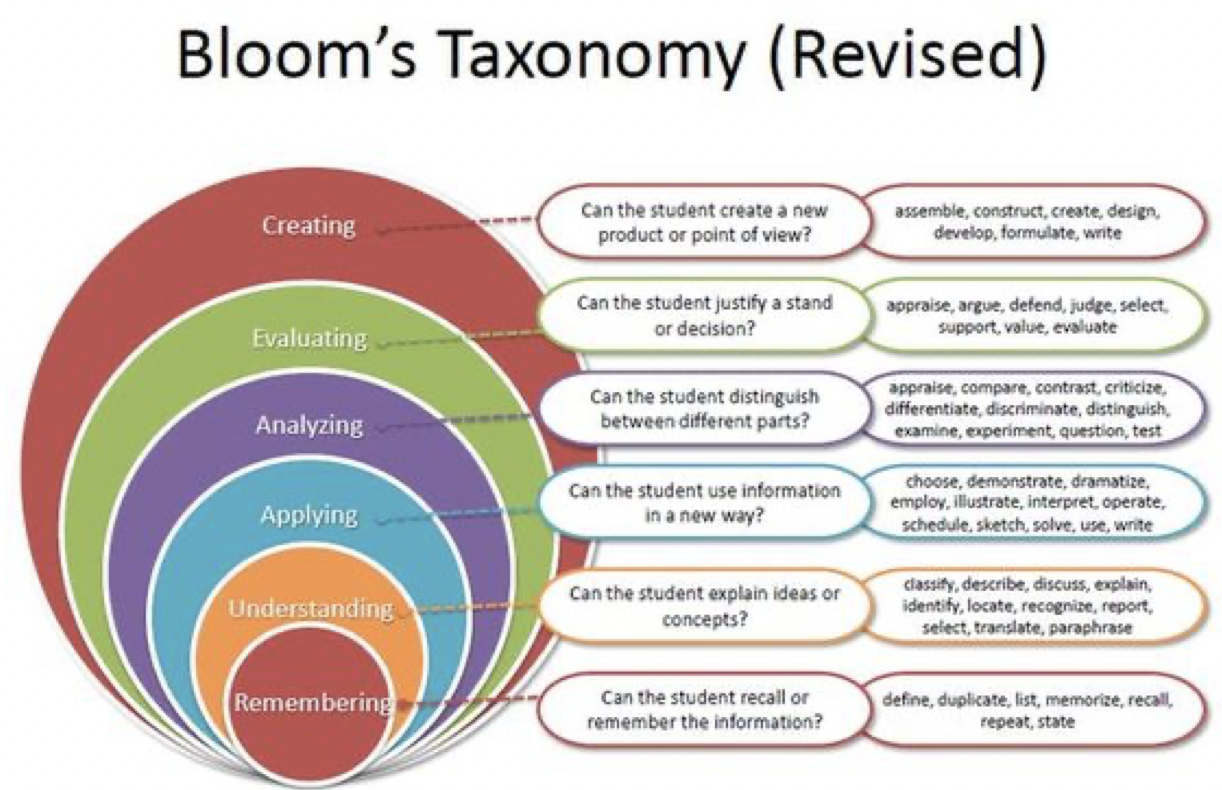
Bloom’s taxonomy provides guidance for asking the type of questions that challenge students to think more deeply about information. The most recent version of Bloom’s sets the levels from lowest to highest as, Remember, Understand, Apply, Analyze, Evaluate, and Create. The graphic above provides ideas for engaging students at higher levels such as analyzing information: “Can students distinguish between different parts?” In this case students would be asked to compare, contrast, or test information.

There are lots of websites that have sample questions for Bloom’s higher order thinking but the challenge for teachers of English learners is to formulate questions that reduce students’ linguistic load while being cognitively challenging. For example, What is the relationship between ________ and ________ ? (analyze)), or Did ________ choose a wise course of action? Give reasons. (evaluate) English learners should be encouraged to demonstrate their knowledge about these and other higher order questions in a variety of ways such as drawing, through drama, building a model, using a graphic organizer, creating PowerPoint slide presentation, and so forth. The purpose is for students to engage in and demonstrate higher order thinking, not to show their level of English proficiently.

Some ways of increasing the use of higher order questions include:

  • Plan for higher order questioning during lesson planning. Several SIOP lesson plan templates have a section for developing higher order thinking skills (HOTS). Planning specific questions ahead of time is important since it’s unlikely that teachers can come up with a variety of good higher order questions on the fly.
  • Teach students about higher order thinking and higher order thinking strategies. Explain to students why they are being asked questions that provoke thought and require them to grapple with an idea or analyze a problem. Making students aware of HOTS helps them understand their own higher order thinking strengths and challenges.
  • Post anchor charts with question stems representing each level of Blooms. These posted resources can be used:
    • To teach students about HOTS and to become familiar with questions at each level (see previous point);
    • By teachers to stimulate class discussions. The visual question starters remind teachers to go beyond literal questions and ask questions that deepen students’ thinking;
    • By students to refer to and use different levels of questioning when working with peers. The charts model how to ask good questions.
    • As students read, urge students to ask themselves questions from the charts to enhance comprehension and engagement with text.
  • Use prompts to stimulate thinking.  Prompts can be placed purposefully throughout the text, asking questions of readers that intentionally emphasize different skills such as inference or analysis.

In post-match interviews, professional tennis players, most of whom are multilingual, are asked to analyze a point, compare their match to a previous one, evaluate their play or that of another. All these questions require higher order thinking and although the players’ English may not be fluent, they are able to think beyond literal levels — just like our students.


4 Ways to Narrow the Opportunity Gap

Unknown

Educators are well aware of the oft-cited achievement gap experienced by English learners. The term achievement gap implies that some students don’t do as well as others academically because they aren’t trying hard enough, aren’t motivated, or aren’t as capable as higher performing students. However, in the past decade there has been growing awareness – and evidence – that there is a pervasive opportunity gap for these students.

A recent report provides some interesting results regarding the opportunity gap. The authors observed nearly 1,000 schools across five diverse school systems and concluded that there are ways to close the opportunity gap. The report recommends that each day students should have the following four resources:

  1. Consistent opportunities to work on grade-appropriate assignments.

The idea that English learners can only be successful if they’re given watered-down materials and assignments has been refuted. Research with the SIOP Model, as well as other studies such as the one linked above, have found that when English learners are provided with appropriate supports, or scaffolds, these learners can be successful in learning grade-level concepts and material and can meet academic standards. Supports are intended to make content comprehensible while at the same time develop students’ English proficiency. Proven supports include:

  • Presenting information in chunks, so that students can process both the concepts presented and the language used. Some English learners may be mentally translating the information and need time to do so. After a chunk of information is presented (or read), ask students to do something to actively process the information such as summarizing it with a partner, answering questions, or filling in part of a worksheet. This process makes large amounts of information more manageable.
  • Pre-teaching vocabulary. Vocabulary knowledge is key to understanding text, however, vocabulary lists in textbooks are usually created for English-speakers. Be sure to select words and phrases that will support readers’ understanding of the story, text passage, or lesson. For example, a math lesson’s objective might be to divide multi-digit numbers using an efficient strategy. Typically, the teacher would select key vocabulary such as, divide, quotient, multiply, dividend, and divisor. These are essential content vocabulary terms for students to know but English learners would likely also need to learn the meaning of efficient and strategy. It is assumed that students know these general academic words, but they are vocabulary terms English learners need to learn for this lesson and for use across content areas.
  • Using graphic organizers. In many content-area lessons there is a lot of information and language for English learners to digest. Graphic organizers provide a visual illustration so that students can better understand the material while also learning its associated vocabulary.

These are but a few of myriad ways to support English learners’ comprehension of grade-level work, and many resources are available to help teachers make grade-level lessons comprehensible for English learners.

  1. Strong instruction where students do most of the thinking in a lesson.

The authors define strong instruction as, “instructional practices that allow students to grapple with appropriate material in robust ways.” Some teachers maintain a mindset that students are empty vessels in need of filling. In fact, students come to school with lots of experience and knowledge and use what they bring as a springboard for new learning. Teaching involves more than presenting information, it includes equipping students to think for themselves, to find information, and to be challenged by new ideas. Some of the most effective instruction I’ve observed is found in classrooms where teachers introduce a topic (or story, or math or science procedure), then students work together to think more deeply about the topic, followed by regrouping for review or sharing students’ ideas. Teachers move seamlessly from whole class to small groups or partners, then back to whole group. Small groups may be used for a quick think-pair-share or turn-and-talk, and at other times a group of 3 or 4 students work together to grapple with an idea or topic, research the answer to a question, or problem solve. Grouping is flexible and there may be several grouping configurations in one lesson, each designed to encourage students to do the thinking. Two cautions related to this point:

  • Be aware of wasted instructional time. A pet peeve of mine is watching time that could be used productively disappear, never to be reclaimed. For example, designed as a way to get students to think about a topic and interact with peers, teachers frequently ask students comprehension or prediction questions such as, “Based on what we’ve read, where do you think our main character will go next? Turn and talk to your elbow partner.” The answer to this question, and most others teachers ask students to discuss, takes about 15-20 seconds, but it is not unusual to observe three to five minutes of valuable instructional time devoted to answering simple questions. Minimal amount of student thinking occurred in this example and the lost minutes add up to hours over the course of a week, a month, a year. English learners are students who can least afford wasted instructional time.
  •  Be careful not to overuse language frames. Used as scaffolds for oral or written expression, sentence frames are effective in helping students communicate ideas using complete sentences and specific vocabulary. Sentence frames are intended to support students in producing language that they wouldn’t be able to produce on their own, but they can be overused which stunts authentic expression as I discuss in this post.
  1. Deep engagement in what they’re learning.

Many students go through the motions of participating in lessons without actually being connected cognitively or emotionally. Compliance is not the same as engagement. Student engagement may be easier to see than describe. In this video, you’ll find students across grade levels working together productively.  Some specific ways to encourage student engagement include:

  • Grouping students to work collaboratively. As seen in the video, students enjoy working with peers on well-structured assignments. Teachers facilitate productivity by first modeling the tasks and showing an example of the final product, then setting time limits on aspects of the assignment, and circulating amongst students to offer assistance as needed.
  • Explicitly linking the topic or assignment to students’ background knowledge and experiences. For example, hook students by asking questions such as, What would you do in that situation? Have you ever had a similar experience? If you were in this situation, what would you advise? Tell us about how your family might react, Based on your own experience, how might you solve this problem? An important aspect of asking probing questions is to really pay attention to what students have to say orally or in writing. Encouraging students to express their thoughts based on their own experiences can be a powerful way to engage with the topic whether it be characterization in a story, an historical event, or a topic in science.
  • Capitalizing on the assets students bring to the classroom by providing activities that are meaningful, interesting and relevant to them. Create student agency by allowing English learners to research topics that interest them, on their own or with peers, and offering alternative means for completing assignments based on their interests, e.g., drawing, writing, or filming. When students are given voice and choice in how they learn, they are more likely to take responsibility for their own learning and engage more deeply in assignments.
  1. Teachers who have high expectations for all students and believe they can meet grade-level standards.

All too often, English learners are characterized by what they cannot do: they cannot speak English, they aren’t prepared for mainstream classes, their parents cannot attend school events. Deficit-based attitudes contribute to low expectations for students’ academic prospects. Decades of research has made clear that If teachers believe that their students are unlikely to learn, they tend to teach in ways that make this expectation a reality. In contrast, most of us are drawn to a person who believes in us and we don’t want to disappoint that person. Students perform better for teachers who communicate high expectations for them. These teachers take time to develop relationships with their students which pays dividends in the classroom. Teachers who have high expectations let each student know that they are important and can be successful. They make comments such as, “I see you finished that assignment. I knew you could do it.” “I appreciate you showing up for tutoring this morning. I know it will help you do well in that class.” Authentic expressions of affirmation signal your confidence in students and can have a positive impact on their success. We would all do well to communicate to students the essence of Mr. Rogers’ approach: You are special. I like who you are.


Writing Effective Language Objectives

Writing language objectives can be hard!

Teachers are generally comfortable writing content objectives because those are based on content standards that teachers are familiar with and are sometimes stated right in curricular materials, e.g., In this unit students will…..

Language objectives, not so much.

Including a language objective in every lesson was popularized by the SIOP Model beginning in 2000 and is now a widely accepted practice. After nearly twenty years, it is the feature about which we continue to receive the most questions, bar none.

In short, content objectives (CO) are related to the key concept of the lesson. Although language objectives (LO) connect to the lesson’s topic or activities, their purpose is to promote student academic language growth in reading, writing, speaking and listening. Writing a LO isn’t always as straightforward as a CO because it is based on an aspect of language that students need to learn. It typically takes more thought and preparation. Fortunately, there are ELL/ELD standards to help guide you in writing language objectives.

In our book, Developing Academic Language, Deborah Short and I provide guidelines for identifying objectives and incorporating them into lessons. These guidelines include determining what we want students to learn (CO) and then considering the language needed to accomplish those objectives (LO). It is important that active, measurable verbs are used in objectives so that learning can be assessed. Students are more likely to take responsibility for their own learning when measurable objectives allow them to gauge their progress. Avoid verbs such as learn, understand, become aware of since these cannot be measured.

In a lesson from a unit on the Lewis and Clark expedition, the unit’s guiding standard is, Explain events, ideas, or concepts in a historical, scientific, or technical text, including what happened and why, based on specific information in the text. A content objective for the lesson might be: Students will identify and describe the main events on the Lewis and Clark expedition.

Language objectives might be: Students will describe the main events using past tense verbs, and Students will categorize vocabulary terms using a List-Group-Label activity.

We promote the practice of posting and discussing objectives with students. An agenda, commonly written by teachers on the board, is a list of activities and is not the same as objectives. Objectives focus on an outcome, not an activity. They are the content-based learning targets students need to be able to accomplish the activities. Remember, objectives are what you want students to know or be able to do by the end of the lesson, so instruction needs to address what you’ve set out to do.

When writing language objectives we suggest that teachers:

  • Have a consistent introduction that students recognize. Pick whichever one will resonate with your students: SWBAT (students will be able to), SW (students will), We will, Today I will and so forth.
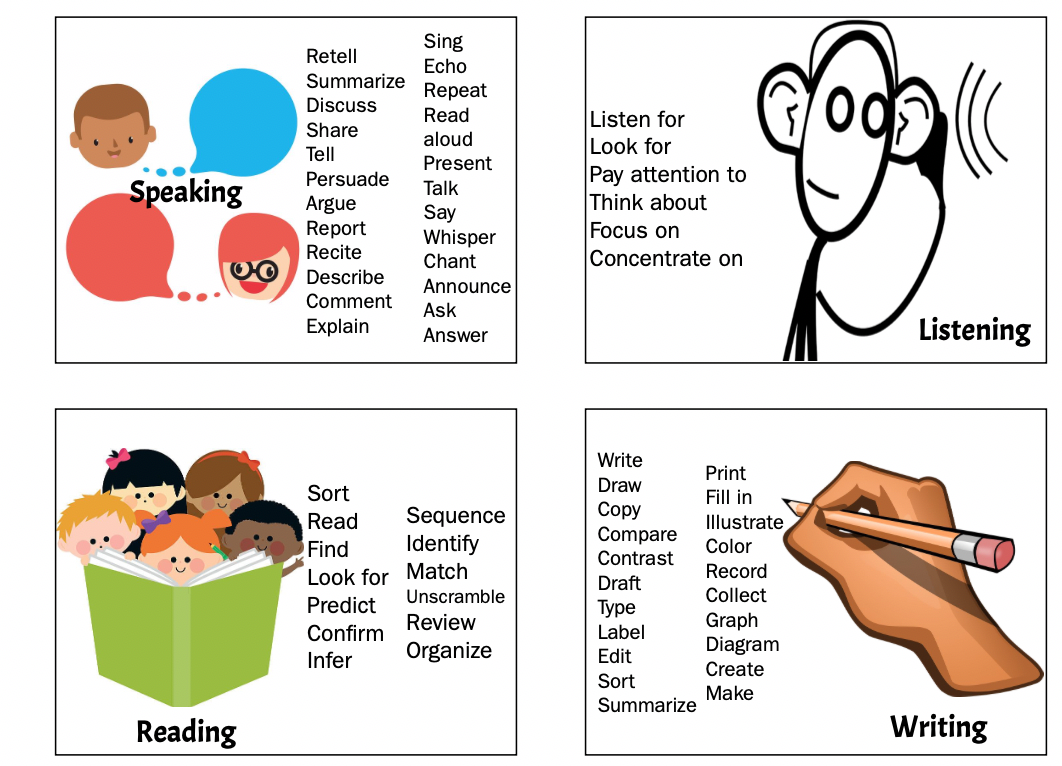
  • State the outcome using active, measurable verbs. SIOPer @carlota_holder created this graphic to illustrate some active verbs that may be used across the four domains.. The lists aren’t exhaustive but are a handy reminder of verbs to use. Some, of course, fit in multiple categories. Compare works in writing and speaking as does persuade.

Screenshot 2019-10-09 19.18.36

In the listening domain above, the objective would need to include an observable, measurable action such as, Students will listen for details and raise a hand when a key detail is mentioned, or Students will pay attention to the presentation and take notes on the outline provided.

  • Focus on the aspect of language students will learn or practice in the lesson. The language feature may need to be explicitly taught or refined and practiced.

So, here’s how a language objective is constructed:

     Students will  describe the main events using past tense verbs.

     Introduction – Active, measurable verb –  Language to be learned or practiced

Additional information may be part of the objective, if desired for clarity:

     Students will categorize vocabulary terms using a List-Group-Label activity.

      Introduction – Active verb  – Language learned    –     Activity

To see objectives in action in a social studies classroom, click here.

One thing is certain, the more you practice writing language objectives, the easier it becomes. Keep in mind a quote from SIOP expert Andrea Rients (@RientsAndrea), “Nobody dies from writing a bad language objective” to which another veteran SIOPer Ana Segulin (@asegulin) replied, “A bad language objective is better than NO language objective.”

Touché!


Post based on : Short, D. & Echevarria, J. (2016). Developing Academic Language Using the SIOP Model. Boston: Pearson.

Echevarria, J., Vogt, M.E. & Short, D. (2017). Making Content Comprehensible for English Learners: The SIOP® Model, Fifth Edition. Boston: Pearson.


Helping English Learners Access STEM

1*ZpKq0Vz1bsyexcv9i-p2mQMuch of the subject matter in science, technology, engineering and mathematics (STEM) education is conceptually complex, which is why it is challenging for many students, and is all the more challenging for English learners. These students are learning English while they tackle complex concepts, high level vocabulary, and dense text. Take, for example, topics such as robotics, electrochemistry, magnetism, phylogenetics, and net forces. Students – and adults – may find some of these topics intimidating but they need not be. Content from any topic area can be made accessible for English learners given the right learning environment.

The SIOP Model is a teaching approach designed to make grade-level content comprehensible for English learners. Its 8 components and 30 features combine to provide teachers with guidance for planning and executing lessons that help English learners become active participants in grade-level learning. SIOP teaching provides access to content by modifying the delivery of instruction so that information is made understandable. Although the content of STEM courses is rigorous, there is evidence that English learners can be successful in these classes. Using effective teaching with English learners is particularly important now as math and science instruction has evolved to include more emphasis on advanced concepts to meet science and math standards.

In SIOP’s Lesson Preparation component, content objectives and language objectives make the purpose of each lesson transparent for English learners so that they know what to expect, and what is expected of them. Objectives allow both teachers and students to focus attention on what is most important to learn, which prepares them for assessments. Content objectives identify what students will learn and be able to do in the lesson, and language objectives address the aspects of academic language that will be developed or reinforced. These objectives should be stated in clear and simple language, posted for the students to see, introduced at the beginning of the lesson, and reviewed at the end of the lesson to determine whether the objectives were met. Sharing objectives with students may lower anxiety about a topic because students can see that challenging subject matter is presented in manageable parts.

Building Background encourages teachers value and use the many assets students bring to the classroom and to build upon them. SIOP teachers make topics relevant by linking academic content to students’ own experiences and language, they activate students’ prior knowledge and fill in where there are gaps in students’ background. There is an emphasis on learning and practicing the vocabulary associated with STEM topics. Many scientific and mathematical terms have Latin roots so words are similar between Spanish and English (or other Latin-based languages such as Portuguese and Romanian), called cognates. Explicitly teaching cognates helps students acquire vocabulary and shows them the relationship between English and their home language.

Comprehensible Input supports English learners’ understanding of instruction as teachers use visuals , multimedia, gestures, well-enunciated speech – any teaching techniques that clearly conveys the message to students and supports their understanding. Another feature of comprehensible input is giving clear instructions for completing tasks, assignments and activities. English learners benefit from instructions that are presented step-by-step, modeled, and written for reference.

Strategies urges teachers to remember that English learners are capable of higher level thinking even when their oral or written expression may be limited in demonstrating their actual knowledge. SIOP teachers ask a variety of questions, some that are literal but many more that promote critical thinking and extend students’ thinking. English learners are capable of learning challenging grade-level material when they’re provided with appropriate scaffolding.

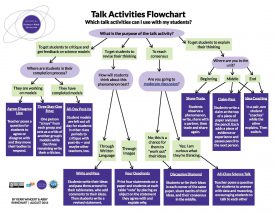
Interaction provides opportunities for students to work together to solve problems, use collaborative inquiry, conduct experiments, research topics, and so forth all the while they are practicing and expanding their lexicon. SIOP teachers encourage students to use language to discuss the content they’re learning, whether in science, (See Talk Activities Flowchart ctafreated by Kerri Wingert and Abby Rhinehart), math, or related content areas.

The Practice & Application component ensures that lessons involve more than paper and pencil tasks. Students practice and apply concepts through activities, games, play, and hands-on tasks. Through the process of practice and application, students refine both their understanding of the content as well as their oral and written expression of those understandings. Much of STEM has application to daily life and the world around us. Skilled SIOP teachers make those connections so that English learners become aware of the relevance of topics to their own lives.

Lesson Delivery guides teachers to make sure that the pace of teaching is appropriate, and that instruction is true to their SIOP lesson plan, meeting the lesson’s content and language objectives. In doing so, each building block of learning is presented clearly and meaningfully.

Review & Assessment calls for frequent checks for understanding to make sure that students are engaged and follow along. Additional scaffolds may be needed such as reviewing, restating, or creating a visual for clarification. In assessing a lesson or unit,   multiple forms of assessment such as presentations,  portfolios, performance assessment, laboratory activities, and group projects are used to ensure that acquisition of knowledge and skills is being assessed. Students’ level of English proficiency may confound assessment results when relying exclusively on written question-and-answer tests.

SIOP teaching supports English learners in accessing STEM content by providing  opportunities for students to achieve academically through high quality, grade-level instruction that is meaningful and engaging, and communicates high expectations for English learners’ success.


Back-to-School: Ways to Build Positive Relationships with Students

34339527

Positive relationships are critical for students to feel connected to school, to do well, and for the overall well-being of the school environment. Building relationships with students begins first and foremost with the Golden Rule: Do unto others as you would have them do unto you. This means to treat students respectfully, ask politely, and correct kindly.

From my experience in observing classrooms, when teachers are encouraging toward students, are respectful, and convey genuine caring, students engage more academically, often because they want to please their teacher. Aggressive or disruptive behaviors are rare. It always amazes me when teachers don’t see how their own behavior — sarcasm and criticism, for example — results in behavior problems. Some students withdraw and disengage in an attempt to stay out of the teacher’s crosshairs while others respond in kind, which often results in punishment for the very behavior exhibited by the teacher. The power differential favors the teacher. In this dynamic, positive relationships are nearly impossible to build — and everyone loses. Often, student behavior mirrors teacher behavior. So, use the Golden Rule as a general guide for making connections with students.

There are also loads of specific ways that teachers can build positive relationships with students but the ones I’ll discuss here are those that I’ve seen work well.

Call students by name. Sounds simple but it isn’t always practiced by teachers and is an easy way to make a connection. At the beginning of the year, learn each student’s name and how to pronounce it correctly. While mispronunciation may seem insignificant, it shows students that you don’t care enough to say their names correctly. And, it can be embarrassing. A name is one’s identity.  In hallways, on the playground, at school activities, take time to greet students by name.

Know your students. Each one comes to school with interests, likes and dislikes, talents, and strengths. Find out about your students and make it a habit to ask about each one: “How was your soccer game?” “Is your brother feeling better?” “Did you play any video games yesterday?” “I see that you braided your hair. It looks nice.” These interactions don’t need to gobble up a lot of time but can be asked as students enter the class at the beginning of the period, as they leave, in hallways or during transitions. The point isn’t to get extensive information but to make a connection by showing you genuinely care. But, when students do need someone to talk to, they’ll likely seek out someone with whom they have a connection.

Communicate high expectations. Most of us are drawn to a person who believes in us. Letting each student know that you believe she or he can be successful will enhance the relationship: “I see you finished that assignment. I knew you could do it.” “Thank you for being on time again today. I know it’s tough for you sometimes.” Display college banners on walls and talk with students about which colleges they want to attend. Have middle school students research programs offered at high schools and encourage them to participate. Sincere comments of affirmation signal your confidence in students and communicate that you are their advocate.

Make home visits. It is one of the most time-consuming yet rewarding ways to building relationships, bar none. Visiting families at home builds goodwill and provides the opportunity to learn about students’ lives and their families’ cultural practices and values. In my experience, it is a worthwhile investment of time because not only does it provide a greater understanding of your students, but a partnership is developed with families which can be invaluable, especially with students who are challenging. If one-to-one visits with each family isn’t realistic, the next best thing is attending community events and introducing yourself to families. These activities aren’t mutually exclusive. Visit the homes of students who need that extra effort made to connect with them and attend an event to meet other families.

Regardless of which of these ideas resonates with you, the point is to build relationships with your students, connect with them every day, and enjoy the benefits.


Increasing English Learners’ Academic Language By Learning About Words

English learners, those students who are still in the process of becoming fluent English speakers, have a lot of English vocabulary to learn. Beyond the words they need to know and use to communicate clearly with others and express their knowledge, ask questions, and convey ideas, they also have to acquire the academic language used in school subject areas, including a level of English that will prepare them to graduate and for college and careers.

That’s a lot of words. One way to accelerate their English proficiency is to instill in English learners the idea that learning about words can be fun. Teaching about words and word parts expands students’ vocabularies exponentially. Of course, there are key vocabulary terms that need to be taught and practiced so that specific lessons are understandable, but there is tremendous benefit to spending time letting students play with words.

English learners have the asset of their home language (L1). They already know a lot of words and the concepts those words represent. Tap into those words and use them to teach English vocabulary, and even expand their L1 vocabulary.

Word generation is used to demonstrate that many words are derived from a common root. Students are shown a root and then brainstorm words that share the root, with teacher assistance or in peer groups. Typically, the words are related to a lesson so students may be asked to look in the text to find as many related words as they can. In the example shofullsizeoutput_608bwn, the root, geo, forms the basis for many other words, as does the root, therm. Awareness that words consist of parts, typically roots and affixes, can catapult vocabulary knowledge to a higher level.

Cognates are words that exists in two different languages and have the same root or origin. Since Spanish and English both have Latin roots, there are lots of words that are the same or very close in both languages. Word generation can be used to teach roots and their many derivations but can also show students the relationship between words in their home language (if Latin-based) and English, e.g., geocentric in English and geocéntrica in Spanish; thermometer in English and termómetro in Spanish. When both languages are posted, bilingual word generation charts bridge the languages.

There are many other ways that English learners can develop word-learning skills. Perhaps the first step is helping students develop word consciousness, which is an understanding that words have meaning and that the meaning of words can be learned and known. For many English learners, it can be sort of an “aha” moment when they grasp the idea that words that may be confounding can actually be understood with use of word-learning strategies. These strategies help them infer meaning or take an informed guess when they come across words they don’t recognize. Learning the meaning of the most common prefixes and suffixes goes a long way in helping English learners figure out unfamiliar words.

Word-learning strategies that are fun — and effective — for developing academic language include the following:

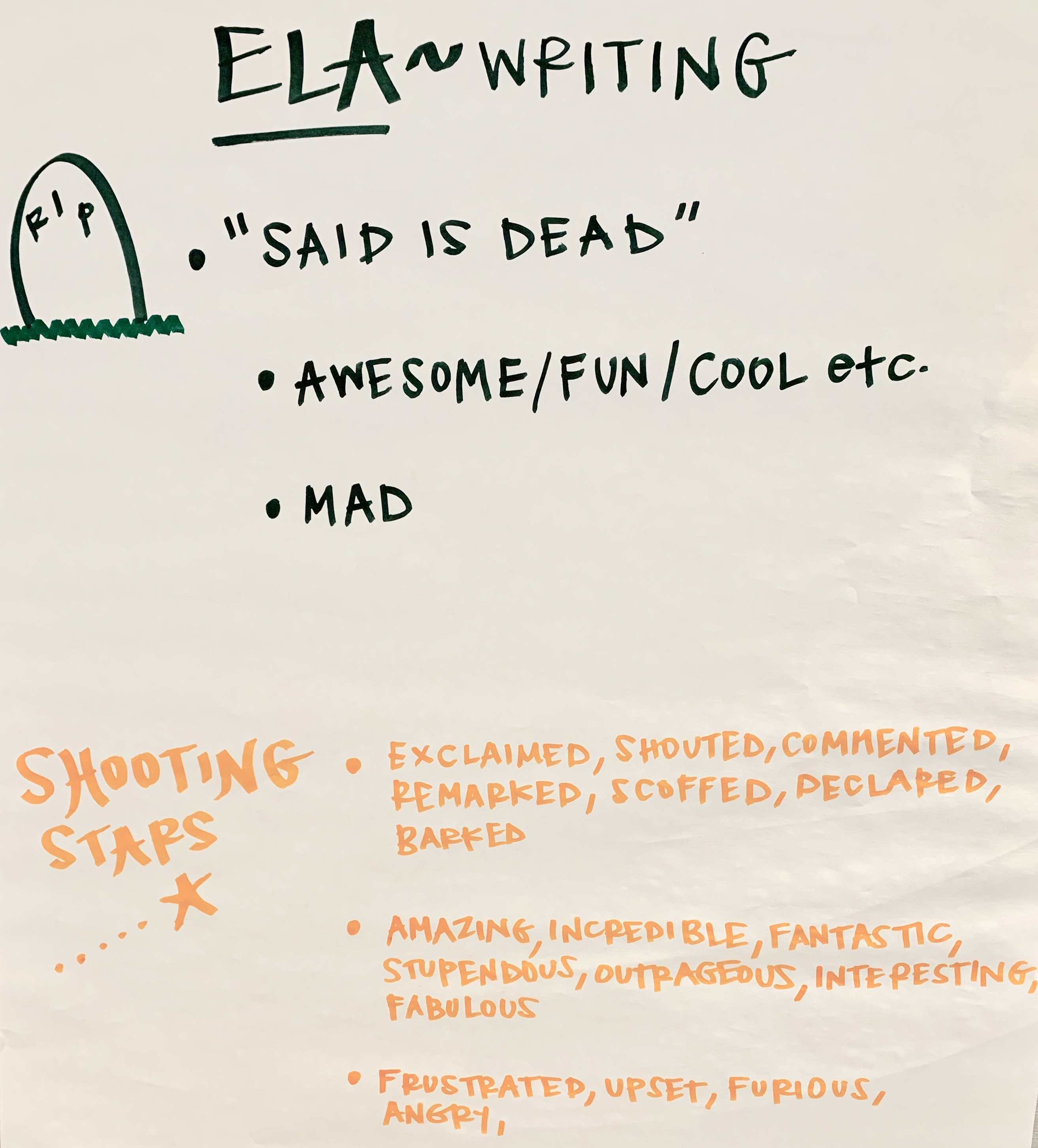
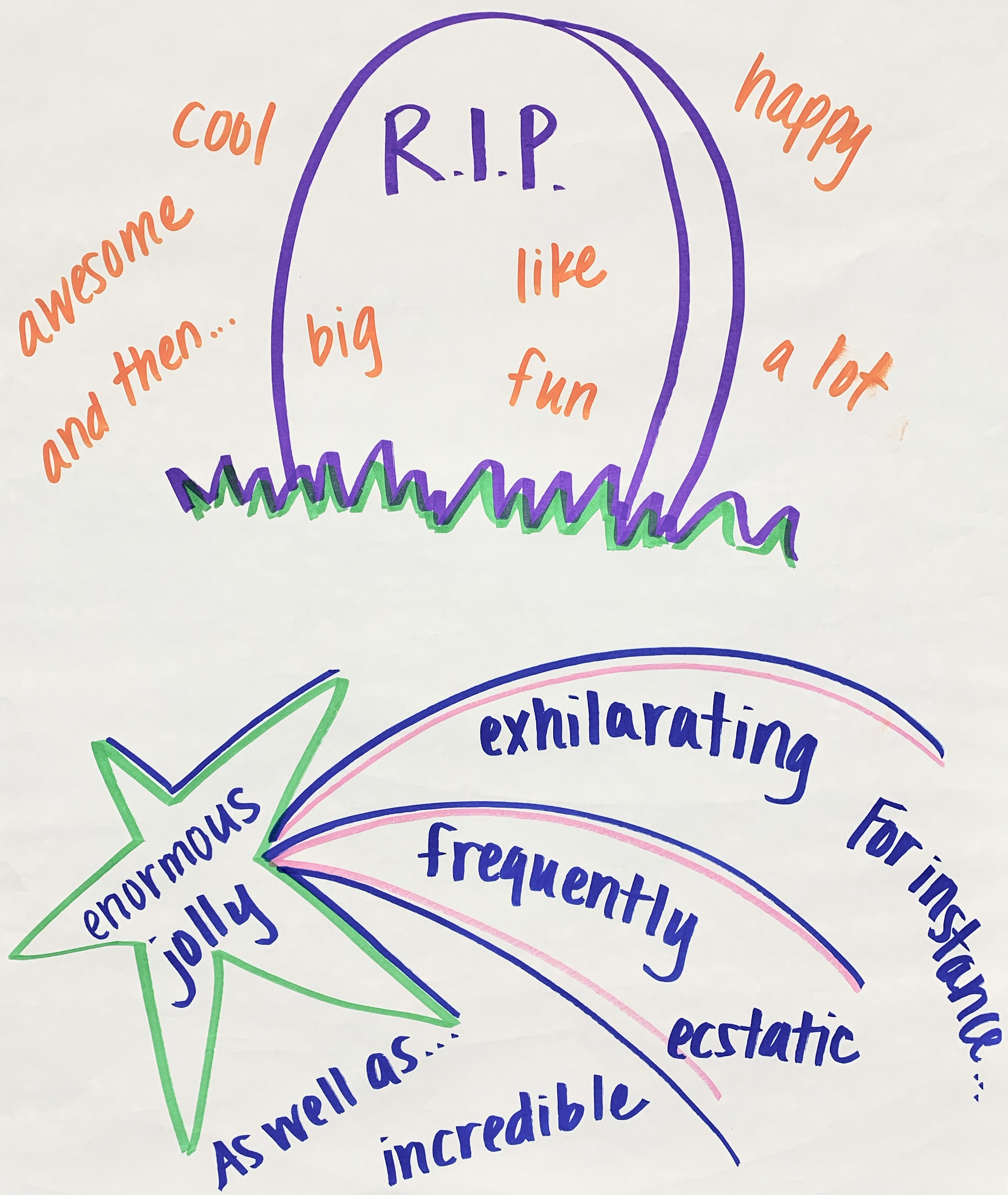
Use synonyms to expand vocabulary. Students tend to use, and overuse, the same words in their writing. In our book, Developing Academic Language, Deborah Short calls these RIP words, ones that need to be buried. Together with students, teachers introduce more descriptive words, called “Shooting Stars,” to replace RIP words. In the examples shown here, the one on the right illustrates how frequently can be used to replace the overused, a lot, andfullsizeoutput_608a

fullsizeoutput_6087enormous replaces, big. Like is an RIP word that can be replaced with, for instance. The poster on the left shows how words such as exclaimed, shouted, and commented are more expressive than, said, and so forth. The point is to make English learners aware that there are a variety of words at their disposal that are more descriptive than the ones commonly used. Further, they are likely to encounter the “shooting star” words in texts so there is a benefit to learning and using them.

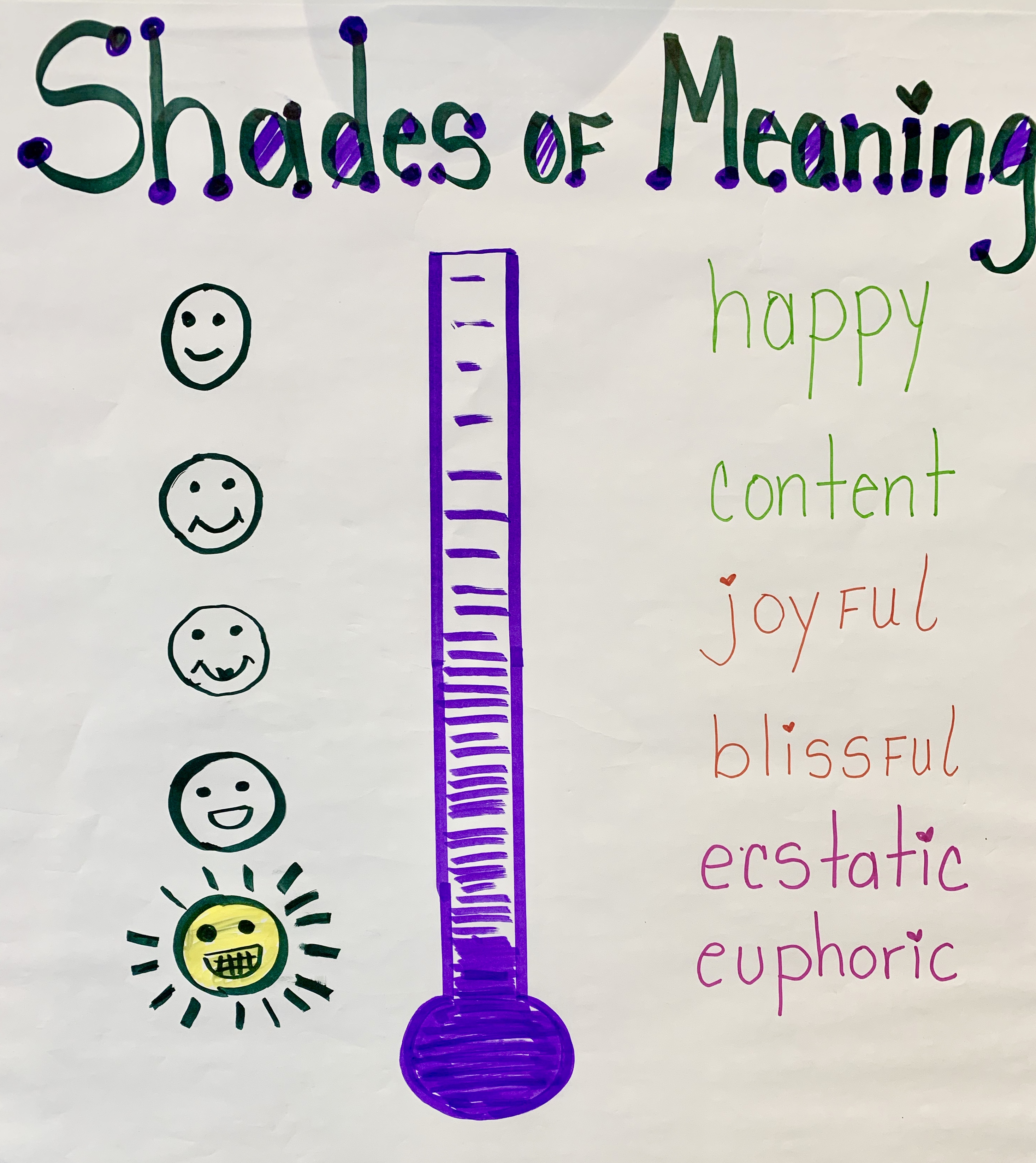
Shades of meaning is another way to use synonyms. Have students come up with an adjective such as happy, seen in the example. fullsizeoutput_6088Then ask students to brainstorm synonyms and rank them by degree. Lively discussion may ensue as students consider and revise where to place words.
Students can have a lot of fun playing with synonyms. They may use a thesaurus to find shooting star words and shades of meaning words, or the teacher may provide a bank of words from which students choose to complete the activity. The important part is to make it a purposeful activity. Further, to provide the multiple exposures to words that English learners need, draw attention to these words when they appear in texts or lectures, when students use the words in writing (make a big deal!) and provide opportunities for students to practice using the words so they become their own.

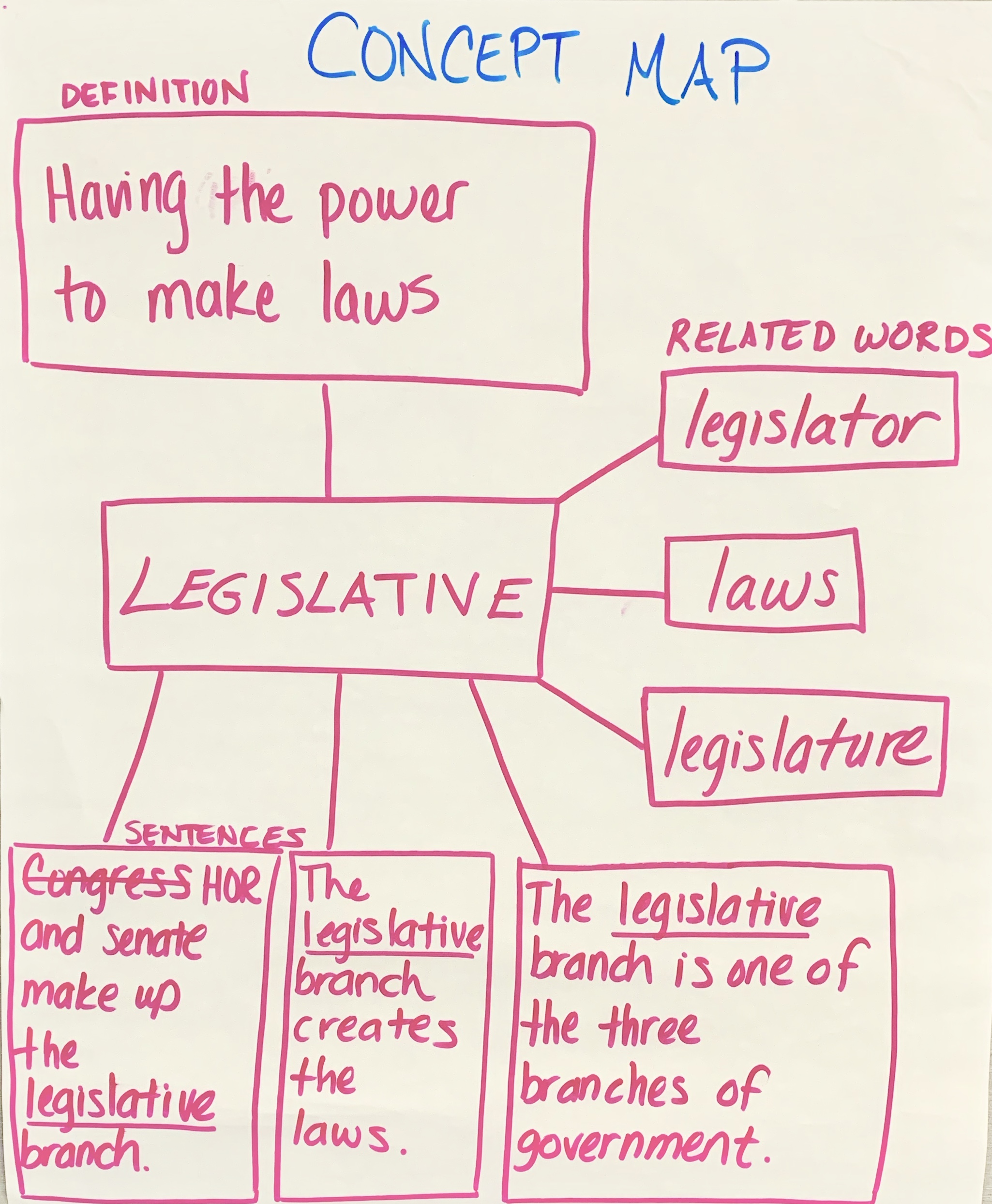
Concept Definition Map is a good way  to develop academic vocabulary and has the added bonus of helping students learn and understand important content information. In the example here, students are learning about the legislative branch of the U.S. fullsizeoutput_608cgovernment. The teacher provides the key term, legislative, and students work together in groups with teacher facilitation to define the key term, generate related words, and write sentences to provide more information about the term, e.g., the legislative branch is made up of the House of Representatives and the Senate. The map also presents an opportunity to teach the root leg, which means law. The teacher points out the relationship between terms such as legal, legislative, legislator, legislature, using visuals for clarity. Learning one term helps students understand other related terms. The poster is used throughout the unit as a reference for understanding concepts and also for expanding academic vocabulary. An individual Concept Definition Map may be created (or copied from the poster) and placed in a student notebook for reference and review.
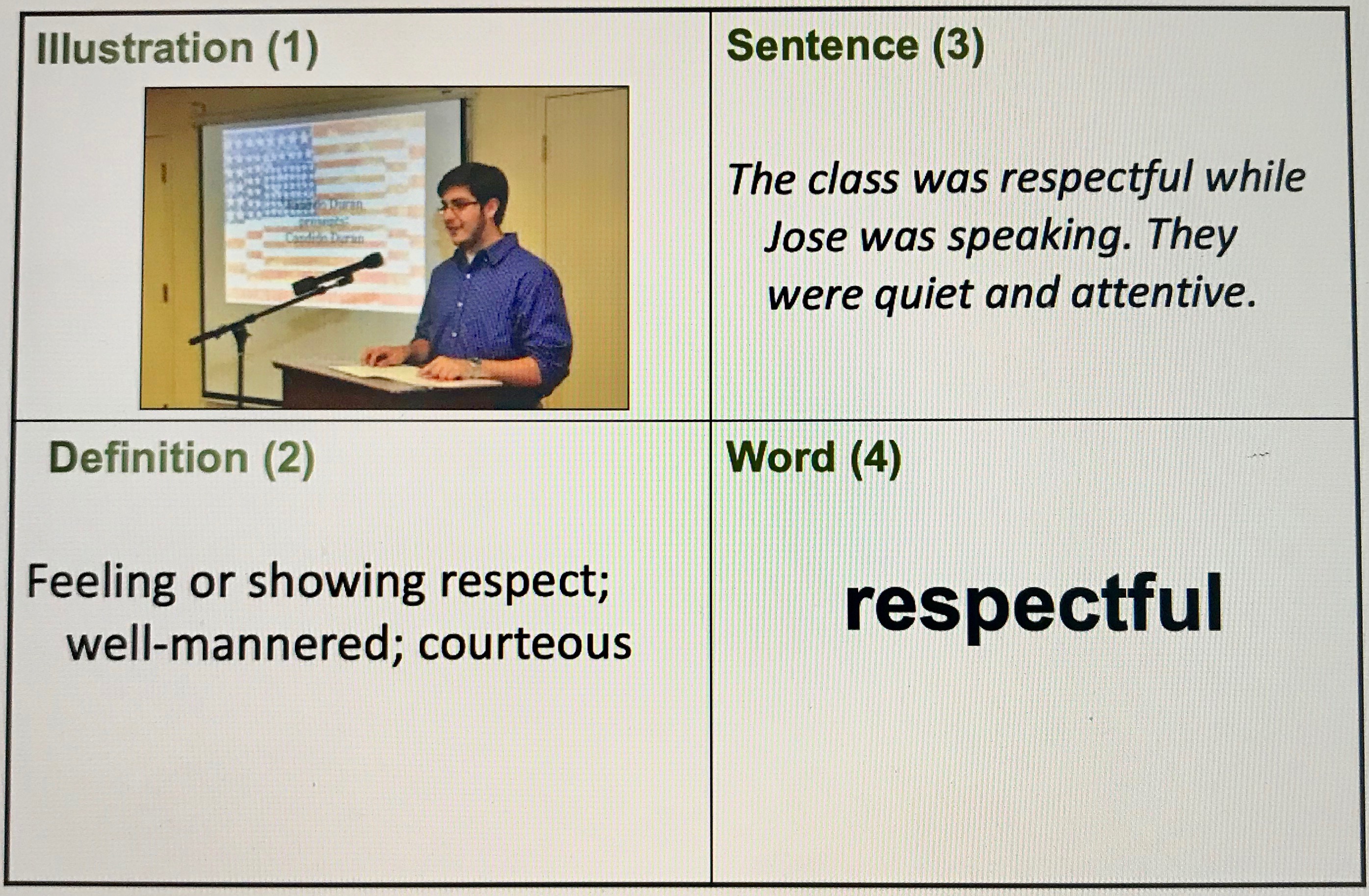
Found Words. In an effort to make learning new words fun, ask student to be aware of words they encounter in their daily lives and bring a new word to class. You might ask students to be on the lookout for a word from the same word family that has been studied, or ask students to find a word in their neighborhood that is interesting and one they want to know more about. Then, talk about the words, explore their meanings, create a semantic map, etc. Make learning new words fun!

By the way, the sample posters shown here were created by participants at the SIOP National Conference this month. To see lots more examples posted on Twitter for teaching English learners, go to #SIOPNC19. Also check out this recap.


4 Routines That Benefit English Learners

Classroom routines are designed for efficient management of classroom tasks and procedures. Instructional routines are intended for learning academic content. Both types of routines are useful for all students, but they are critical for English learners.

Most individuals like structure and are more comfortable knowing what to expect in a given situation. The bell schedule provides schools with a structure or routine. Students and teachers alike know what to expect when the lunch bell sounds, right? Imagine working in a school without a routine or schedule. I bet the unknown would create a fair amount of discomfort and anxiety.

Classroom routines are important because they let students know your expectations. Students will likely perform better academically when they know the parameters of the day or class period. Class should begin the same way each day and follow consistent routines for tasks such as collecting homework, passing back student work, distributing materials, moving from whole class to small group, checking out technology, assigning roles in small group discussions, and so forth. For English learners, knowing classroom routines provides comfort and security thus lowering their affective filter. Predictable patterns become familiar to English learners which means that they don’t have to try to make sense of oral instructions for each task or transition. Classroom routines also save valuable time that can be spent on instruction.

Instructional routines — the way that a lesson or activity unfolds — are important for English learners so that they can focus their intellectual resources on learning content and language rather than trying to figure out what the teacher said about what to do. The SIOP Model advocates for beginning each lesson by reviewing posted content and language objectives. Objectives make the focus of the lesson transparent for students and draws attention to the specific language to be learned and/or practiced.  Another feature of SIOP encourages teachers to clearly explain the lesson’s tasks and activities, writing the steps for students’ reference. This practice minimizes students’ confusion because they can refer to the board for “next steps” in the lesson.

The following are additional instructional routines that support English learners. To encourage use of academic language during discussions, the teacher explicitly teaches key vocabulary words at the outset of the lesson. By using the key words during discussion routines, English learners reinforce their understanding.

  1. Take a Stand.  The teacher begins by making a statement to the class related to a current event or the lesson’s text such as, “Arctic and Antarctic animals do not differ significantly.” Allow quiet time for thinking and then give the cue, “Take a Stand,” asking students to stand if they agree with the statement and stay seated if they disagree. Students must be prepared to explain their rationale for agreeing or disagreeing with the statement. For students who need scaffolding, provide the following sentence frames for student responses:   “I respectfully disagree with                       because             .”   “I agree with                    because                         .”  Take a Stand can also be a team activity with four to six students per team. The team first discusses the statement made by the teacher, comes to consensus on whether they will sit or stand, and on cue, the entire team stands or stays seated. They then explain their rationale for agreeing or disagreeing. An adaptation to this discussion routine is to allow students themselves to create the statements used for agreeing or disagreeing and ask the rest of the class to respond.
  2. Think-Pair-Square. This discussion routine adds a twist to Think-Pair-Share by increasing accountability and participation. Sometimes teachers ask students to turn to a partner and share but the “share” is superficial. With Think-Pair-Square, the teacher asks an interesting question and students think about their answer, then they discuss their answer with a partner. Finally, the partners turn to another partner pair and share what they discussed. This process requires more complex thinking as each student listens to a partner’s input, asks for clarification as needed, compares it with one’s own ideas and if the partner’s ideas differ, they discuss their different perspectives. Then they turn around and explain what they discussed to another group, all of which adds depth of understanding and provides a higher level of language use.
  3. Elbow Partner Exchange.  Initially, two students engage in a discussion about a topic related to the lesson. In math, for example, students are given a problem and together they list questions they have about the problem or note possible solution strategies. They sign their names on the paper and then exchange their information with another set to partners who address the notes the previous pair wrote. So, they might answer the questions listed or add their own ideas to the solution strategies. They sign their names next to their contributions. As the teacher reviews the Elbow Partner Exchange sheets, he can zero in on what the students know and what they still need to learn. The benefits to this discussion routine are that students practice using academic language and they clarify their own thinking as they hear the perspectives of their peers.
  4. Show What You Know. This routine requires a topic that has 2 to 4 possible dimensions or qualities (e.g., animals, food, aspects of a historical event). In this example, the Food Pyramid is the topic. Each dimension, such as protein, fats, dairy, fruits, vegetables, grains, is assigned to a specific area in the classroom and is labeled with pictures or words representing the dimension. The class is divided into six groups and assigned to an area where there are resources related to the topic’s dimension (e.g., protein). Students use the resources to learn about their particular food group so that they become experts on the topic. After they’ve read together an article or other material about their food group, students use the information to create a small poster that explains the food group. Each group of “experts” will Show What You Know by teaching the rest of the class about their food group. After presenting what they know to the class, their poster is added to the whole-class chart on the Food Pyramid.

Routines are beneficial because students have done the activities before, and since they know what to do when, who is expected to talk when, and when they are expected to write something down, they don’t have to spend much mental energy on how to get it done. The structure of the routine frees them up to focus on the academic task at hand and in so doing, they also practice using academic English in purposeful ways.

Based on:

Echevarria, J., Fisher, D. & Frey, N. (2016). How to Reach the Hard to Teach: Excellent Instruction for Those Who Need It Most. Alexandria, VA: ASCD.

Vogt, M. & Echevarria, J. (2008). 99 Ideas and Activities for Teaching English Learners with the SIOP® Model. Boston: Pearson.

6 Ways to Enhance English Learners’ Academic Oral Language

I came across an interview with the author of the book, Tell Me More, who was discussing the value of simply listening. It occurred to me that much of what was being discussed also applies to teaching. Students, like any individual, want to be heard, understood, listened to. How often do we as teachers (or administrators) quickly move to “fix it” mode without really listening to what a student is trying to convey? In these situations, oral expression is hampered.

Why is that an issue? Because developing oral language skills is a big deal.

Research shows that oral language has a significant impact on students’ success throughout their academic careers. In particular, oral language is closely tied to reading achievement. English learners have a knowledge gap in oral language because these students didn’t grow up speaking and listening to words in English about the world around them. Specific time in class must be dedicated to developing their oral language skills, especially use of academic language.

Here are six ways to enhance academic oral language for English learners. These ideas are drawn from our book, Developing Academic Language.

  1. Create a positive, respectful and supportive classroom environment. English learners are more likely to talk to the teacher and peers, and to participate in academic discussions when they are comfortable doing so. The teacher sets the tone in the classroom and for oral language to be enhanced, the right tone is one of acceptance, encouragement, respect for differences of opinion or perspectives, and welcoming of all attempts to use the new language. Students benefit from teachers’ use of relationship-building language such as, “I’m listening, go on…” and “I’d like to hear what else you have to say about ____________.”Valuing and validating student contributions goes a long way in creating a positive learning environment and reducing the risk involved when using a new language in front of others.
  2. Select interesting topics for discussion. One of the best ways to engage students – or anyone for that matter – is to discuss a topic of interest. Topics need to be appropriate for their age and related to the curriculum so that English learners are exposed to key topics covered at their grade level. Think of ways to tie students’ personal experiences and background to the topic so that they make personal connections. Show a picture or video clip to generate discussion and ask, Does this remind you of anything? What do you recognize? How does this relate to our topic? Also, be sure to encourage students to express their own opinions using techniques such as Take a Stand where students move to a corner of the classroom marked with a sign that reflects their view on a given topic: Strongly Agree, Agree, Disagree, Strongly Disagree. Small groups at each corner discuss a plan for presenting their ideas to the group, then each group shares their position.
  3. Encourage active listening. English learners need instruction in developing strong listening comprehension skills such as learning how to filter out some of the “English noise” they hear by focusing in on specific information and listening with a purpose. One way to develop active listening is through note-taking. Show students that as they listen for the purpose of taking notes, they can pick up teachers’ speech cues that reveal important information. Cues that signal key information include change in intonation, emphasizing a word or phrase, and repetition. Also, teach students common phrases teachers say to help them home in on important information such as, “Ok, this is important,” “Be sure to remember this,” “Make a note of what I’m saying,” “Here’s something important.” Knowing what to listen for encourages active listening.
  4. Provide scaffolds for expressing ideas. Sentence starters, language frames, sentence frames and/or scripts have become commonly used scaffolds to support English learners’ oral expression. They provide a model of correct English grammar as well as giving a boost to oral participation since some of the words are provided. For example, the frames,  In the text ________________ is arguing _______________ , but I think ________________. and, If ________________ then ________________ provide authentic language for English learners to use as they express their own ideas and draw conclusions. Remember to provide scaffolds that match students’ English proficiency levels and to remove scaffolds as needed. As I discussed in a previous post, advanced speakers should not be asked to use frames designed for those at the beginning stages of English proficiency. Some English learners may not require much scaffolding at all as their fluency increases.
  5. Plan for multiple opportunities to practice using English. To improve oral proficiency, English learners need to engage in lots of meaningful practice activities that link to content and language objectives. But high-quality practice is unlikely to happen unless it is part of lesson planning. On-the-fly “turn and talk” about a topic is less effective than planned activities with small groups or partners discussing content topics using targeted vocabulary and/or specific grammatical structures. There are innumerable resources online and in books where teachers will find fun, interesting, and meaningful activities for developing academic oral language. Make sure that lessons have sufficient time devoted to such instructional activities.
  6. Reduce teacher talk. The best way to get someone to talk is to listen. Teachers of English learners need to reign in their instincts to talk – to share more and more information, and to go into “fix it” mode when students have questions. Prompting (“Ok, what else?”  “And so….”) and pausing (remaining quiet and allowing students to finish their thoughts) are much more effective for encouraging extended oral expression. Consistently using techniques such as prompting and pausing creates a classroom environment that has a balance of teacher talk and student talk, one in which students feel comfortable expressing themselves. English learners are apt to use English more when they are confident that they won’t be cut off and when the teacher genuinely wants to hear their ideas.

 From: Short, D. & Echevarria, J. (2016). Developing Academic Language Using the SIOP Model. Boston: Pearson.


Teaching English Learners: What Does the Research Say?

In a recent podcast I encouraged educators to use research-validated teaching techniques and strategies for supporting English learners. So, I thought it might be useful to post a blog about using research to guide instruction.

A research report has identified seven guidelines for educating English learners in grades K-5. These guidelines provide the “what” that should be happening in classrooms. The “how” to make it happen can be guided by SIOP which is supported by research .

(By the way, there is an excellent SIOP twitter chat at #ELLchat_bkclub where teachers are posting lots of great, practical ideas and activities to use with English learners. Check it out!)

  1. Provide explicit instruction in literacy components. There has been a lot of discussion recently about how students learn to read. While it’s important to enrich reading instruction by providing read alouds, book choice, and ample time for independent reading, students — especially English learners — need to be taught the essential skills of reading daily. That is especially true since English learners are unlikely to learn those skills incidentally. Students can’t become good readers if they don’t learn to decode well, but English learners need to make connections between the words they are pronouncing and the meaning of those words. SIOP IMG_4829teachers pre-teach key vocabulary so students can comprehend the text in front of them, and they use students’ background literacy knowledge and experiences to connect to text. Some of the innumerable ways that SIOP teachers make skill instruction meaningful include 4 Corner vocabulary (see example), contextualized word walls and personal dictionaries.
  2. Develop academic language in the context of content-area instruction. Our mantra for decades has been, all teacher are language teachers. Each content area has its own unique way of using language and its own associated vocabulary (e.g., disunion and emancipation in history; photosynthesis and respiration in science) in addition to general academic vocabulary used across content areas such as, chart, subsequently, and symbol. One of SIOP’s most significant contributions to teaching English learners was introducing a focus on having content and language objectives in every lesson. During lesson planning, teachers consider the language students will need to be able to understand and participate fully in each lesson. The lesson’s vocabulary, sentence structure, and/or language skill (e.g., retell or persuade) become language objectives. Posting and reviewing content and language objectives makes learning transparent for students and ensures that academic language teaching is infused into content-area instruction.
  3. Provide visual and verbal supports to make core content comprehensible. This recommendation is most fully reflected in the SIOP component, Comprehensible Input. Use of multimedia, charts, pictures, and even jotting words/sentences and drawing simple illustrations during oral presentation of information increases comprehension. Verbal scaffolds include paraphrasing or restating a student’s response to model correct English grammar, and eliciting more language from students by prompting, cueing and gesturing rather than accepting a one- or two-word response. Verbal and visual supports encourage greater student engagement and learning by making content comprehensible.
  4. Encourage peer-assisted learning opportunities. The Interaction component of SIOP calls for frequent opportunities for interaction and discussion using a variety of grouping configurations such as moving from small groups to partners or from whole group to small groups. For English learners, engaging with peers in discussion around text provides deeper understanding of the content and allows them to use academic language in a non-threatening setting. Oral language is developed by interacting with language in ways such as Think Pair Share, and through more in-depth discussions where students grapple with ideas and practice defending their positions. Let’s face it, students enjoy working together productively, especially when they understand their roles and tasks are well organized. Changing up grouping provides variety and interest.
  5. Capitalize on students’ home language, knowledge, and cultural assets. English learners come to school with a wealth of background experiences and knowledge. The Building Background component asks teachers to explicitly link instruction to the assets that students bring and build upon what they know and can do. Further, SIOP calls on teachers to provide ample opportunities for students to use their home language to clarify concepts. SIOP teachers use techniques such as chapter previews, asking students what they know about the topic, discovering experiences they have had related to the topic, and encouraging students translate key terms and concepts into their home language. Integrating students’ language, knowledge, and culture into the classroom communicates respect, honors their background, and enhances learning.
  6. Screen for language and literacy challenges and monitor progress. English learners sometimes are passed along with the assumption that learning difficulties are because they “just need more time to learn English.” The idea of the research  recommendation is to screen for issues, do something concrete as a remedy, and monitor how well the remedies work. Progress-monitoring data tells us if basic classroom instruction for English learners needs to be improved or if both improved instruction and additional targeted interventions are called for. Disproportionate numbers of ELs identified as needing interventions is a signal that effective instruction is missing in the classroom. Resources would be better directed toward improving professional development for staff on effective teaching for English learners. In a previous post, RTI and English Learners: 4 Considerations, I make the point that RTI isn’t about, What is wrong with this student? but should be about, How can we meet the instructional needs of this student?
  7. Provide small-group academic support in literacy and English-language development for students. A dedicated time of daily  instruction, typically called ELD or ESL, gives English learners a chance to focus on developing vocabulary and other language skills that will improve English proficiency as well as assist in the acquisition of literacy.  By using core content as the vehicle for learning during ELD/ESL, language is learned in context and important knowledge and concepts are reinforced through language practice. English learners also need focused instruction on how to use English in various ways and for specific purposes, and small group instruction with peers of similar English proficiency levels provides the best opportunity to improve both language and literacy for these students.

In secondary classrooms, many of these same guidelines apply but are adjusted for age.  For example, secondary teachers use more collaborative, peer-group learning to support and extend teacher-led instruction. They also provide appropriate scaffolding to ensure that grade-level texts and other instructional materials are used and are accessible to English learners. The urgency associated with teaching older learners requires a more intense focus on developing academic English — its varied grammatical structures and vocabulary  — as part of subject-matter learning, as well as attention to fostering student motivation and engagement in literacy learning.

Online resources provide easy access to research about teaching English learners. Let’s make sure we’re using research-based practices to improve the academic achievement of our students.