Expanding Sentence Frames to Enhance Academic Language Development

Academic language has important implications for both teachers and students since success in school is achieved largely through spoken and written language. But academic language is challenging for students, particularly for English learners.

Most English learners develop conversational English fairly quickly, typically in 1 to 3 years, since this type of interpersonal language tends to be concrete and is highly contextualized with speech supported by gestures, facial expressions, and body language. Academic language, in contrast, is more formal and abstract and is characterized by features such as more complex sentences (e.g., embedded clauses and conjunctions), precise, abstract vocabulary (e.g., representational democracy in social studies and characterization in language arts), and rhetorical forms (e.g., figurative language or rhetorical questions). Unlike conversational language which students experience in everyday settings, academic language is found almost exclusively in school. 

The importance of developing academic language should be made transparent to English learners. In fact, most children recognize, even at an early age, that language is used in different ways to do different things. They speak in different ways to their friends than they speak to teachers, and they have learned to talk in particular ways in public situations such as a visit to the doctor or at church. Likewise, students use conversational language at times in class discussions but they also need to be taught the academic language that’s used in a variety of ways across content areas.

One way to develop academic language is through the use of sentence frames, also called language frames. These are used widely as a way of providing support for English learners in oral discussions and writing. Examples include:

I think that __________ because ___________________.

I agree with ______________ but would also add _____________________.

Sentence frames are intended to support students in producing language that they wouldn’t be able to produce on their own. The frame provides a model of academic language that is just beyond their current level of proficiency. Students are able to express their ideas more coherently, with support, using correct sentence structure and academic vocabulary. The idea is that after repeated use students internalize the vocabulary and sentence structures which then become part of their linguistic repertoire. 

Since frames are a support, they are differentiated by language proficiency level, providing the right amount of scaffolding needed. The eventual goal is removing frames altogether once students are proficient enough to express themselves using authentic language without support.

For example, a beginning speaker may use a frame, I think _____________. The next level night be, I think __________ because_____________, and a more advanced speaker may use, In my opinion ______________ and the evidence that supports my opinion is _______________________. As you can see, with minimal tweaking, teachers can provide more simplified frames for beginning speakers and more complex sentence structures and vocabulary for more advanced speakers.

Differentiating frames by proficiency level isn’t hard or time-consuming for teachers to do, and the effort is well worth it. Practice with the right frame may advance students’ English acquisition by allowing them to use academic language that is comprehensible for their level of proficiency.

There are innumerable basic sentence frames that are effective such as,

  • My favorite character is ___________ because ____________.
  • The ___________has __________sides/angles.
  • The ___________ revolted against the ______________.
  • First __________,then____________, next____________, and finally __________.
  • _____________ was caused by______________.
  • The experiment demonstrated _________________.

However, teachers might also consider expanding sentence frames in outline form for extended use of academic language, and as a scaffold when reading grade-level texts, which can be difficult and frustrating for EL students. The teacher creates and saves a completed outline of a text’s or lesson’s content. Students use the outline as a guide while reading the text, listening to an audio-recorded version of the text, listening to a mini-lecture, or watching a video. These outlines can be differentiated, as shown below. For students who need less support, some of the detail from the outline can be removed, leaving most headings and some key academic vocabulary. For those who need more support, icons and simple illustrations can be added as additional clues, and the first letters of key vocabulary and concepts also may be included on the outline as hints.

In a science unit on photosynthesis from our new book, 99 Ideas and Activities for Teaching English Learners with the SIOP Model 2e, the outline here uses extensive academic language but it’s scaffolded to be accessible for all students. Students’ completed outlines can be referred to multiple times to reinforce academic language and the lesson’s concepts and, for example, as review for a test or to provide background information during subsequent lessons.

Sample completed Framed Outline

Title: Photosynthesis
I. Difference between animals and plants
     a. Animals consume food for energy.
     b. Plants produce/make their own food.
II. Photosynthesis
     a. Process that plants, algae, and some bacteria use to make their own food.
     b. Process of using the sun and water to make food (sugars) from carbon dioxide.
             i. Carbon dioxide comes from people and other animals
     c. Produces oxygen and glucose (sugar) as food for energy.
     d. Excess (extra) oxygen is a byproduct (something made but not used by the   plants), is released and is used by animals to breathe.
     e. Plants use glucose for:
              i. Energy
              ii. Later use
              iii. To build new parts on the plant


Sample Framed Outline for Intermediate and Advanced Speakers

Title: Photosynthesis
I.  Difference between animals and plants
       a. Animals ____________________________________________________
       b. Plants ______________________________________________________
II.  Photosynthesis
       a. Process that plants, algae, and some bacteria use ____________________
____________________________________________________________.
       b. Process of using the sun and water to ______________________________
              i. Carbon dioxide comes from _______________________________
       c. Photosynthesis produces _____________________________________ for      
          __________________________________________________________.
       d. In photosynthesis, oxygen ________________________________________.
       e. Plants give off _________________, which animals need to breath.
       f. Plants use glucose for:
              i.     _____________________________
              ii.    _____________________________
              iii.   _____________________________

Beginning speakers learn the same grade-level content but are provided visual supports to make the content understandable. As an additional support, beginning speakers may work together or partner with a more proficient English speaker to complete the outline and discuss the concepts.

Sample Framed Outline with Pictures

Title: Photosynthesis
I.    Difference between animals and plants  
    a. Animals__________________________________________________Shape

Description automatically generated with low confidence

    b. Plants _______________________________________________   A picture containing grass, outdoor, plant, lush

Description automatically generated
 
II.   Photosynthesis
      a. Process that plants, algae, and some bacteria use _____________________.
     ____________________________________________________________.
      b. Process of using the sun and water to Text Box: + A picture containing wheel

Description automatically generated
       ______________________________________ .

            i. Carbon dioxide comes from ___________________________.
      c. Photosynthesis produces ______________________________________
         for ______________________________________________________.
      d.     In photosynthesis, oxygen ________________________________________.
      e.     Plants give off _________________, which animals need to breath.
      f.     Plants use glucose for:
             i.     _____________________________
             ii.    _____________________________
             iii.   _____________________________

Sentence frames are valuable tools; they support English learners in expressing their ideas orally and in writing. Consider taking sentence frames to the next level through outlines that enhance comprehension of a lesson’s content and provide practice using academic language in context.

Advocating for Long-Term English Learners

Rosendo eagerly began kindergarten but since he spoke little English, it was difficult to understand his teacher most of the time. He liked ESL time because the teacher showed visuals with written words and gave his small group lots of opportunities to practice using the words. In class he tried hard to complete his work, but he wasn’t able to make the same academic progress that most of his classmates did by the end of the year, especially in reading since the sounds were new to him and the words didn’t make sense. Rosendo’s struggle continued for the next few years. He wanted to do well and please his teachers but had difficulty making meaning of printed words, and the explanations the teacher gave to the class were unclear. Although his teachers were nice, he often felt invisible. By fourth grade he could converse well in English with his teacher and peers but understanding and completing academic work remained a challenge. 

It has been estimated that between one-quarter and one-half of all students who enter elementary school as English learners like Rosendo become long-term English learners, or LTELs. LTELS are considered those who after five years haven’t yet been able to demonstrate adequate proficiency in English to meet established English language proficiency criteria and to be considered fluent English proficient.  

As more schools return to face-to-face instruction, it seems like an opportune time to re-focus on supporting EL students in gaining proficiency in English, especially those students who are LTELs.

A common perception is that children who fall behind simply “need more time” to learn English, but what they actually need is daily engagement in meaningful listening and speaking activities along with scaffolded reading and writing experiences, those that allow EL students to successfully learn literacy skills and build and expand those skills over time. Multiple daily opportunities to develop both social and academic language and use it to express themselves orally and in writing are essential. 

So, the bedrock of advocating for LTELs is to provide them with consistent, high-quality instruction, teaching that is meaningful and relevant and that capitalizes on the assets English learners bring to the classroom.  

High-quality instruction for LTELs (and other English learners) begins with using research-validated instruction such as the SIOP Model, an approach for making instruction comprehensible while at the same time advancing students’ English language proficiency. SIOP classes are student-centered and welcoming where English learners have opportunities to use language in authentic ways, collaborating with peers around concepts and information, practicing and applying the material to meet the lesson’s objectives.  SIOP provides teachers with a coherent approach for planning and delivering relevant, meaningful lessons that provide ample opportunities for students to interact with one around content concepts aligned to state and national standards. While doing so, students’ develop academic English skills across the four domains–reading, writing, listening, and speaking.

SIOP ensures that grade-level content is accessible and provides opportunities for students to use language in authentic ways. High quality content instruction coupled with a specific time of daily, focused English language development (ELD) is a combination that is sure to offer ELs the best support for gaining proficiency in English.

The proportion of English learners who become LTEL students is concerning. It is a complex issue with any number of contributing factors such as absenteeism and transiency. However, schools can do a lot to reduce the numbers of LTELs.

When discussing EL services, it’s important to keep in mind that English learners are entitled to language support services until they are sufficiently proficient in English to be successful in general education without such supports. These necessary – and legally required – services provide equity of access to schooling for those students who are still in the process of learning English.

Unfortunately, many LTEL students languish for years in EL programs without making sufficient progress towards English proficiency. The solution is not lowering the bar for exiting programs but improving the quality of instruction these students receive and focusing on the areas where growth is needed. After all, EL services are a scaffold, or support, that is in place until students have acquired the language and literacy skills to be successful academically after exiting the program. The goal is acquisition of language and literacy skills, not simply exiting the program.

In some cases, English learners are isolated from English-speaking students in separate classes and don’t receive sufficient exposure to grade-level, rigorous instruction that is scaffolded for them. This linguistic isolation also deprives English learners of opportunities to learn and use higher levels of English.

Even with appropriate classes, SIOP teaching, and ELD, there may be issues that hold students back from reaching proficiency and exiting EL programs. The following suggestions assume English learners already have been provided high-quality instruction.

  1. Implement a school-wide approach. Everyone benefits when students make academic progress. However, too often school personnel view English learners as the responsibility of an EL coordinator or similar staff person. Especially in schools with large numbers of ELs, a team effort will more likely increase the number of ELs who reach proficiency and are ready to exit EL programs. School staff should:
    • Meet with each English learner from 4thgrade on to discuss the areas they need to improve, i.e., speaking, listening, reading and/or writing. Be transparent about assessment results and set goals for improvement in the area(s) of need. These meetings should probably take place more than once a year to keep students and school personnel focused on their set goals.
    • Design an efficient system for data collection and reporting. Ask a group of principals how many students exited their school’s EL program the previous year and likely few could answer accurately, probably because they depend on their EL coordinators to check on English learners’ progress. Every district has established criteria for exiting EL programs such as cut scores to define proficiency on state language proficiency assessments, demonstration of “basic skills,” teacher recommendation and so forth. School staff, led by the principal, should be proactive in analyzing each English learner’s progress toward meeting these criteria and a system should be in place for doing so: Who monitors progress toward exit criteria? What happens when some English learners are close to meeting exit criteria? (Hint: The students’ teachers are informed and instruction then is focused on targeted areas.) Who gathers the paperwork and submits it to the district? Lost paperwork or lax procedures are not valid excuses for keeping students in EL programs when they are ready to exit.
  2. Enlist teachers. Teachers need to be knowledgeable about their EL students’ levels of proficiency in each of the domains of reading, writing, speaking and listening. Assessment results are used to create an instructional profile for each student so teachers can more easily focus on areas targeted for growth for each student. For example, many LTELs like Rosendo have solid listening and speaking skills but fall short in reading and writing. Rather than spending lots of time on “turn and talk” type activities, teachers should focus on literacy skills by providing lots of opportunities for ELs to read (with scaffolds, independently, with a partner and with the teacher), talk about what they’ve read, write a response, reaction or summary, then share it with a peer. Interesting discussions around text coupled with writing activities will advance students’ proficiency in all domains.  Conversely, some language assessment tests have a speaking component whose format makes it difficult for English learners to display their speaking abilities accurately. Many students become inhibited when asked to speak into a computer or microphone or to construct their oral response in a particular way. Provide practice in speaking in the ways required on the assessment, e.g., speaking clearly into a computer, projecting their voice, and using the response format required on the test.
  3. Involve students. LTEL students have taken a language proficiency assessment every year since they entered U.S. schools. Some students become weary of taking the same test with the same results. Most have no idea how they performed on the assessment, only that they remain an EL student. There is value in getting buy-in from students and a good motivator is choice: secondary students in EL programs have limited electives because they take ELD for one or two periods. Be explicit with students that if they will double down on their effort in the classroom and during ELD they will likely perform better on the next assessment. Further, encourage students to:
    • Give their best effort on the test. Let them know that every answer counts.
    • Come prepared by getting a good night’s sleep the night before test day and eating breakfast on the day of the test. Most students (English learner or not) aren’t aware of the impact of sleep and nutrition on performance.
  4. Enlist parents’ help. This valuable resource is often overlooked, and research shows that when EL parents are asked to assist with school work, they do. Ask parents to:
    • Help with the student’s target areas by supervising their work. For example, if reading goals are set, ask parents to make sure their student reads at home each day. Teachers may design an accountability system for reporting work done at home.
    • Make sure their student attends school on testing day, is on time, and well rested.
    • Encourage the student to do their best on the test and take it seriously.

When English learners aren’t making adequate progress academically, the first step is to examine classroom instruction and determine if it offers the supports needed for attaining English proficiency. 

Next, consider the four suggestions offered to improve English learners’ performance on exit criteria measures.

With growing numbers of LTELs nationwide, it’s important to advocate for our English learners with an “all hands on deck” approach, supporting each one in reaching English proficiency and overall academic success.

(A version of this post appeared on January 10, 2019)

Achieving Equity for English Learners with SIOP

My district has supposedly been told by our State Department of Education that the SIOP English language development (ELD) class is a violation of students’ civil rights. Since then, we have had many English learners NOT graduate or they have to come back for a 5th year since they lacked English Language Arts (ELA) credit. Can someone illuminate this issue for me?

Recently I have received a couple of questions similar to this one, so I thought it was important to take this opportunity to clarity some misperceptions and misinformation that is floating around. This question, and others like it, reflects two issues: 1) How SIOP is used in schools and 2) How credit toward graduation requirements is assigned in high schools. 

First, the SIOP Model is not an educational program, per se. It is a proven approach for teaching English learners (ELs) in a variety of settings. SIOP classes offer EL students opportunities to use language in authentic ways, collaborating with peers around grade-level concepts and information, practicing and applying the material to meet the lesson’s objectives. SIOP provides teachers with a coherent approach for planning and delivering relevant, meaningful lessons that provide ample opportunities for students to interact with one another around content concepts aligned to state and national standards. While doing so, students develop academic English skills across the four domains – reading, writing, listening, and speaking. A fundamental aspect of SIOP teaching is to make lessons culturally relevant by integrating students’ background experiences, language, and culture into lessons.

The very essence of SIOP is to offer English learners equitable access to the same curriculum and instruction as English-speaking students. Application of SIOP teaching includes:

  • Sheltered instruction classes. SIOP is used in classrooms of all grade levels and across all content areas. Some secondary schools offer sheltered classes for English learners such as sheltered biology and sheltered social studies. In elementary schools, especially those with large numbers of ELs, sheltered teaching is a part of daily instruction. Research has shown that all students benefit from the strategies and techniques used in SIOP teaching such as posting and reviewing content and language objectives, explicitly teaching vocabulary, using visuals, providing hands-on learning and opportunities to practice and apply new concepts and vocabulary, and so forth. Research studies on the effectiveness of SIOP demonstrate that student achievement in both acquisition of content and language outpaced that of students in control (non-SIOP) classes. 
  • ESL/ELD classes. English learners receive a dedicated instructional period where the focus is on English language learning using content-based curricula. SIOP teaching can be used during ESL/ELD. 
  • Newcomer programs. Students who are recent arrivals to U.S. schools require specialized instruction that addresses issues such as orientation to the ways of American schools, interrupted education, and limited formal literacy experiences. These students require intensive language learning beginning with social English in low-risk situations and vocabulary building. SIOP teaching makes lessons comprehensible for these students.

In these three language support programs, the goal is to move English learners through ELP levels so they eventually exit ELD, and to progress through sheltered instruction classes to general education content courses.

  • Dual language programs. SIOP can be part of dual language programs when students are studying content through their new language. For example, in a dual language program with English-speakers learning Mandarin and Mandarin speakers learning English, SIOP teaching makes the content understandable for each group of students. 
  • General education courses. Teachers can also continue to use SIOP, or some features of SIOP, as needed by the English learners in their classes. 

Although the SIOP Model has eight components, it is not a step-by-step approach. Rather, it is an integrated system for lesson planning and teaching that ensures that critical features of instruction in combination are present in every lesson. Furthermore, it allows for natural variation in teaching styles and lesson delivery because the SIOP Model is curriculum- and materials-neutral. It has been successfully adapted for use in a variety of settings and cultural contexts worldwide.

Equity and SIOP

The question of equity and SIOP is perhaps rooted in confusion about the federal guidelines. In our work with districts for the Department of Justice, investigations into possible abuses of English learner civil rights vis-a-vis education, it is clear that SIOP is an acceptable model for ELD and for content courses. However, an issue arises if students are in ELD classes exclusively all their time in the EL program and never in regular ELA or supported ELA, such as co-taught ELA. DOJ would suggest that ELP Level 4 students receive general education ELA with supports. Concerns around students’ civil rights are likely based on these programmatic decisions.

The issue is linguistic isolation, not SIOP implementation. Equitable means giving EL students the resources they need to reach parity, and sheltered courses using the SIOP Model is one resource among several to support students in reaching parity. 

The second part of the teacher’s question is about credit toward high school graduation. In some states a sheltered ELA course or ELD course might qualify for core ELA credit because it meets the standards; in others it might not. At this time there isn’t a uniform policy regarding how credit is assigned for English learner classes. 

5 Considerations for Maximizing English Learners’ Language Acquisition

The pandemic has been challenging for all of us — teachers, parents and students. Many English learners, however, are being disproportionately challenged by current modes of service delivery, because of inequitable learning opportunities created by the digital divide. 

Even for those students who have adequate devices to use for learning and have sufficient internet connectivity, one reality of the pandemic is reduced instructional time whether it is face-to-face, online, or a hybrid approach. The time that English learners have with teachers should be spent using practices that are most effective in building their English language proficiency so that they can better access grade-level materials and instruction, thus enabling them to participate more fully in class. 

Now seems to be a good time to review some of the factors that affect second language acquisition since instructional time is at a premium. In this post, 5 factors from our book, Sheltered Content Instruction, will be discussed along with ideas for enhancing language acquisition. 

First, it is important to remember that:

  • Language represents only one aspect of an individual. Focus on teaching the whole child rather than viewing language as the only aspect that needs support. 
  • English learners have language differences, not deficits. Build on the assets students bring from their home language. 
  • Second language acquisition is a complex process. There are many factors that influence why some students seem to learn English more quickly than others and this can’t be explained by a single factor.

1. Motivation                                                                                                                         

Recognizing the need to learn the second language and being motivated to do so are key ingredients for second-language learning. Research indicates that some students are motivated to integrate into another language group while others are motivated to learn a new language for practical reasons such as finding a job or passing a test. The latter type of motivation is not as effective in mastering a second language since it tends to involve short-term goals. The desire to integrate into a group increases the likelihood of becoming proficient in the second language because it involves developing personal relationships that are potentially long lasting.

Another way to look at motivation is to think of “investment” as a way to depict the relationship between the learner and the target language (e.g., English). Sometimes a learner may be highly motivated to learn English but may nevertheless have little investment in the language practices of a given classroom. The classroom environment may not be supportive and inclusive, and the student may perceive an uneven balance of power between English speakers and English learners. The resistance to being part of that type of class impacts the student’s language learning. 

To enhance language acquisition:

  • Examine your own practices and attitudes to ensure that English learners are treated equitably and are regarded as valued members of the class. 
  • Encourage English learners to develop relationships with English-speaking students by assigning shared responsibilities, having students work collaboratively on assignments, and assign activities that promote getting to know one another.  This can be done with remote teaching as well as face-to-face.
  • Become familiar with and acknowledge each student’s social/cultural identity. Recognizing a student’s social/cultural identity makes a meaningful connection between a learner’s desire to learn a language and maintaining their own identity.    
  • Particularly with older learners, be aware of teacher behaviors that may create anxiety, frustration or embarrassment, emotions which can hamper learning. 
  • Remember without the contextual clues that occur naturally in face-to-face teaching such as teacher facial expression and pointing, English learners in online teaching settings may be less motivated to participate. To the extent possible, be expressive, use bitmojis to convey an idea, and use other visuals to maintain motivation.                                                                                                                                 

 2. Personality                                                                                                            

Extroverts tend to prefer the social aspects of relationships such as talking, playing, and working in collaborative groups so they have increased opportunities for interaction and practice using English. As a result, they develop social language quickly. Introverts, those quiet or shy students, are temperamentally prone to be reflective and prefer working alone or with a partner rather than in a large group. Therefore, teachers shouldn’t, for example, urge introverted students to speak up in front of the whole class or encourage them to be “more outgoing.” With respect to temperament, there is a saying that extroverts conspire to convert introverts to be like them. Most introverts learn that there are times they need to move out of their comfort zone and be more social, but their innate preferences are not something they will “grow out of.” Likewise, extroverts need to learn, for example, to defer to others rather than dominate a discussion. 

Some of the considerations about personality have cultural and linguistic implications as well. While the distribution of introverts and extroverts is found throughout humankind, beginning English learners and newcomer students may resemble introverts in their behaviors. For instance, newcomer students may appear shy and reticent because they are unfamiliar with American educational practices such as working collaboratively with peers, engaging in contests and participating in discussions. Beginning English speakers will likely be reserved about speaking English aloud and shouldn’t be forced to speak before they are ready, especially in front of the class.  

 To enhance language acquisition:

  • Remember that students are more likely to practice using English when they are in a setting that is comfortable for them. 
  • Within activities that appeal to extroverts such as competitive games and assignments, create roles for introverts where they will be more comfortable such as letting them judge a contest, document a discussion, or create questions.
  • Respect student differences and, to the extent possible, provide opportunities for each to shine in their own way. 
  • Keep in mind that both types of students can learn to interact well with peers but don’t force socialization that may intimidate some students.
  • With remote teaching, introverts may be more comfortable with their camera off. Please see https://twitter.com/MrsParkShine/status/1300401054404796416 for an excellent idea by Esther Park to accommodate different learners in an online setting. 

3. First-Language Development                                                                                                       

Learning a first language, although a natural process, is complex and requires a minimum of 12 years. Although a tremendous amount of language is acquired from birth to age 5, children from ages 6 to 12 continue to develop more sophisticated forms of semantics, phonology, morphology, syntax, and elaborated speech. Certain aspects of language development such as vocabulary expansion continue for a lifetime.

Research reveals that one’s level of first-language development significantly influences second-language development. Students who have had the benefit of schooling in their first language are more efficient at acquiring a new language. Strong oral language and literacy skills developed in the home language provide a solid basis for the acquisition of language, literacy, and other academic skills in English. Those who achieve full cognitive development in both languages will gain the cognitive benefits of biliteracy; when development of the first language is discontinued, there actually may be negative consequences.  Many English learners who have low literacy levels find it difficult to catch up academically in the second language, a language they do not yet fully comprehend. Continued first-language instruction is beneficial since the deeper the conceptual foundation, the higher the ability to build.    

To enhance language acquisition:                                                                                                                                          

  • Do not discourage or restrict use of students’ first language at school or at home. (Obvious exceptions would be tasks that require the use of English, such as oral presentations, written assignments or assignments designed to practice using academic English.) Students benefit from clarifying concepts, information and terminology in their first language with peers or the teacher so that their learning doesn’t lag. The more students develop their first language, the better prepared they will be to learn English. 
  • Encourage parents to create a language-rich home by talking, singing, telling stories, and so forth. When parents use their native language, their children become familiar with word order and patterns, rhyming, vocabulary, and concept development—as well as background knowledge upon which to build. Sending home books or links to websites in their home language can also foster language and literacy development.
  • With time at home, remote teaching may benefit English learners in balancing assignments and activities completed in their first language with family support, and assignments in English. 
  • Explore offering dual language or bilingual programs at your school so that students can develop a strong foundation in their home language.

4. Access to the Language                                                                                                                 

Research shows that English learners benefit from opportunities to use the language with English speakers, and adolescents demonstrated stronger English proficiency outcomes when they had opportunities to use English in informal settings such as in their neighborhoods, at work, with friends and in the hallways of school. In classrooms, language acquisition is fostered when English learners work in collaborative groups with English speakers since these activities allow English learners to practice using English and the context itself makes English accessible. However, simply hearing the language doesn’t provide access. Many of us come into contact with speakers of other languages in various settings, but we don’t actually learn the language when we hear it spoken. In the same way, English learners may spend many hours hearing English in school without really accessing it in any meaningful way. Learning requires contextual clues to make the message understandable, which is why conversational language is more readily developed than academic language. Social conversations are inherently full of clues while academic language is much more decontextualized and requires high-quality instruction to be accessible for English learners.                                                                                                          

To enhance language acquisition:

  • Plan multiple opportunities for English learners to interact with English-speaking students through partner work, group projects, paired reading and other ways to ensure that English learners are accessing the language in meaningful ways. 
  • With remote learning, English learners might partner with English speakers in breakout rooms to engage in partner reading and other activities. 
  • Encourage participation in extra-curricular activities so that English learners have access to English-speaking peers outside of the classroom.
  • Use teaching techniques that make academic content comprehensible for English learners so that they can more easily access its meaning. (See #5 below)

5. Quality of Instruction                                                                                                      

Fundamentally, effective instruction begins with having high expectations for students. The attitude and expectation that English learners can and will learn grade-level material are reflected in high-quality instructional practices:

  • Follow consistent daily routines
  • Engage in lesson preparation 
  • Use visuals, multimedia and other contextual clues to make teaching meaningful
  • Build on students’ background knowledge and experiences
  • Model use of instructional strategies 
  • Acknowledge sociocultural factors that affect English learners 
  • Implement techniques for differentiating instruction
  • Provide opportunities for students to practice and apply new information and skills
  • Use assessment-informed instruction

These practices positively impact English learner outcomes, including language acquisition. Researchers have suggested that many learning problems experienced by students learning English are pedagogically induced, or the result of instructional practices that are not suited to the learner, sometimes resulting in inappropriate placement in special education. Effective language learning takes place in well-organized classrooms where teachers use instructional practices that are effective for English learners. If instruction is not made comprehensible and accessible for students, the opportunity to learn both English and academic content material decreases.                                                                                 

To enhance language acquisition:

  • Develop clear content and language objectives so that students know which aspect of language is the focus of the lesson.
  • Use instruction that is based on research-validated practices, listed above.
  • Provide opportunities for interaction with the teacher and peers that allow students to use elaborated language around relevant topics, building English skills while at the same time developing content knowledge. 

Some of the suggestions for enhancing language acquisition are impeded to one degree or another by remote teaching. However, all can be used at least to some extent depending on your own situation. For example, interaction can take place in online breakout rooms. 

These are challenging times for educators. Hopefully this post will serve as a reminder about the linguistic needs of your English learners and provide you with some use-tomorrow ideas to enhance their language acquisition. 

Aren’t All Teachers Language Teachers?

Many content teachers have made a significant investment in preparing to teach a specific subject area such as science, math, social studies, music, and so forth. It’s natural that their focus is on teaching the content topics in their area of expertise. Elementary teachers also teach a variety of subjects and tend to focus on the topic at hand whether it is teaching a science lesson or poetry. Few would disagree that language permeates all topics and subject areas.  

In this time of remote learning, teachers are experiencing the reality that many students, English learners and English-speaking students alike, are challenged by the rigorous content and skills associated with high academic standards. Meeting standards is challenging when teaching face-to-face but is even more so in a remote environment. 

It’s important to keep in mind that English learners are learning the same content as other students, but they are reading, writing, listening and speaking a language in which they are not yet completely proficient. What a difficult job they have!  

At the same time, these students are developing a level of English language that English-speaking students and teachers typically take for granted, such as stating an opinion, asking for permission, clarifying a statement, and reading written instructions. Also, they’re learning lots of high level of academic vocabulary.

It’s easy to see that English learners might disengage from remote lessons when the lesson’s content and instruction are well beyond their level of English proficiency.

In planning and teaching lessons, attention to the linguistic needs of English learners is critical for them to be able to participate fully in lessons and learn academic content. Effective teachers, those whose English learner students thrive, intentionally teach language and content simultaneously. 

In reality, all teachers are language teachers. Teachers with English learners in their classes need to think about ways to integrate language into content lessons. Every content area — math, science, language, arts, history — requires students to use language in a particular way. For example, texts in social studies tend to use more expository writing which differs from a narrative story in English language arts that uses metaphor. 

The academic language used in school is particularly challenging for English learners because it differs from the everyday language students “pick up” in day-to-day life. It is more grammatically dense and formal than the kind of language found in conversations at home and with peers. It includes more sophisticated and technical vocabulary, complex sentence structures, and rhetorical forms that are used almost exclusively in academic settings. It’s unlikely that English learners are exposed to this type of language outside of school. 

Integrating language into content lessons begins with lesson planning. In designing lessons, focus on the purpose of the lesson and its associated language by writing both content objectives (What students will learn, based on standards) and language objectives (The language students need to be successful in the lesson). Ask yourself:

  • What vocabulary do students need in order to understand the content?
  • What kinds of language functions do I need to teach, e.g., compare and contrast, use of superlatives, or making predictions?

The answers to these questions become your language objectives. Then think about meeting those objectives and ask:

  • When in the lesson will I explicitly teach the language needed?
  • What activities will I plan that provide opportunities for students to use language and meet the objectives?
  • What scaffolds will I use to make the lesson more comprehensible, e.g., visuals or a partially completed outline?

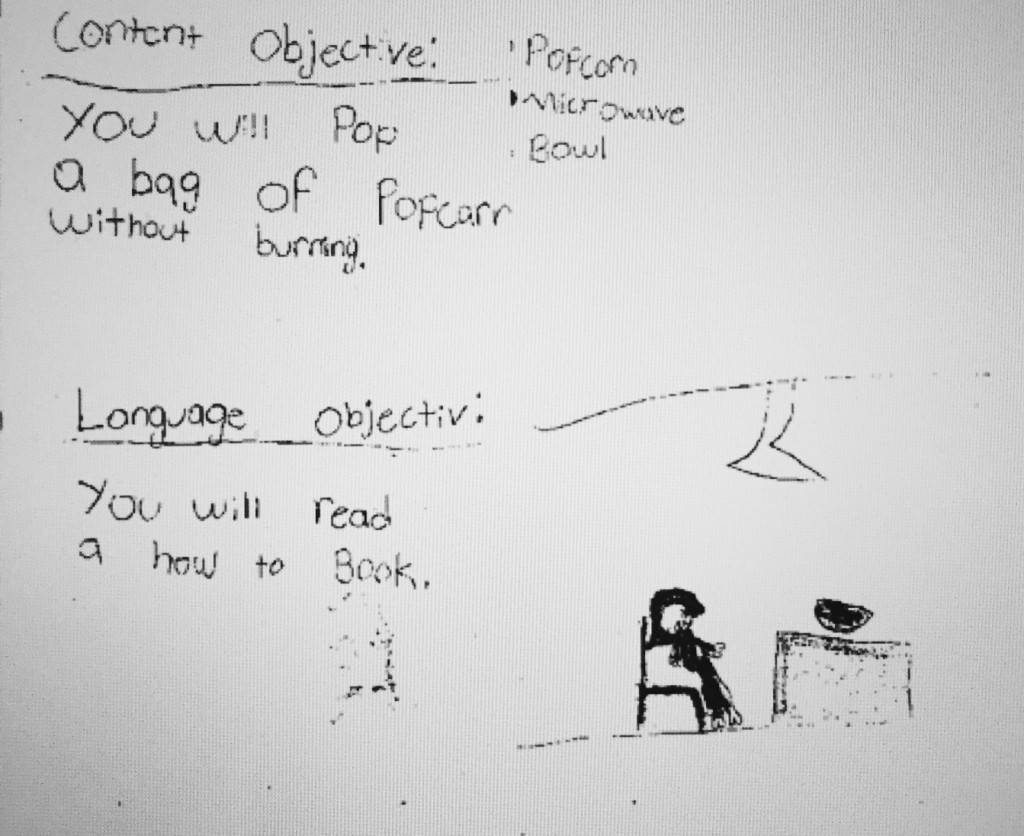
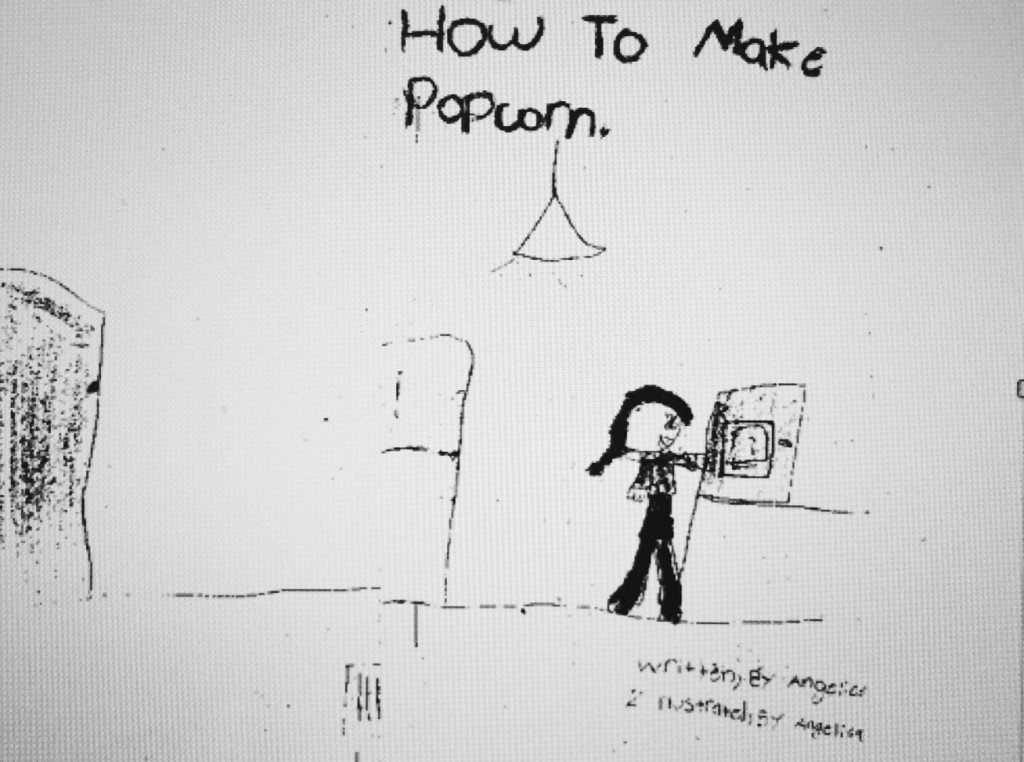
When teachers post and review objectives with students, students internalize the idea that both content and language are the focus of learning.  By way of demonstrating the power of making students aware of the lesson’s objectives, let’s look at what happened in a second-grade class. The class had been reading “How To” books and the assignment was: Think of something you can do. Write a “How To” book of your own.  One English learner surprised her teacher with the following beginning to her book:

Book Cover

It’s evident that Angelica learned that both content and language are important. In fact, her objectives are actually quite good!  She even listed the materials needed: popcorn, microwave and bowl.

Routinely posting and reviewing content and language objectives helps teachers think about the language demands of the content lesson they are planning. And, it lets students in on what they are learning and why. Potent stuff.

Since language is an integral part of learning content, English learners benefit when teachers think through the language demands of lessons and teach students what they need in order to learn the lesson’s content information and skills. Indeed, all teachers are language teachers.

Based on: Echevarria, J., Vogt, M.E, Short, D. & Toppel, K. (2024). Making content comprehensible for Multilingual learners: The SIOP Model, Sixth Edition. Boston: Pearson.

Short, D. & Echevarria, J. (2016). Developing Academic Language Using the SIOP Model. Boston: Pearson. 

(A version of this post was published on February 22, 2016)

Five Steps to Family Literacy for English Learner Families

The advantages of parent involvement in their child’s school life are well documented. Students’ academic achievement is positively impacted when their parents are involved in their education, no matter how academic achievement is defined. A meta-analysis of studies found that the relationship between parent involvement and student achievement was strongest if parental involvement was defined as parents’ expectations for the academic achievement of their children. One could argue that parents, especially those of English learners, need to know what the expectations of school are for their children in order to support them in meeting academic expectations. 

There are myriad ways to create family-school partnerships with English learner families. A unique family-school program at a middle school in Texas created a path for parent literacy called, English for All. It went beyond the typical adult ESL programs offered to communities as an outreach method. One goal of the program was to create a student-centered school, one in which families become an integral part. Further, classes were geared to the needs of the parents rather than simply being an English language class. Finally, the program offered an avenue for speaking to parents about their student’s performance in the classroom. 

In order to recruit participants for the program, a letter was sent home to the families of all EL students at the school describing the benefits of the program and the nature of the classes. The letter was written in both English and Spanish. Parents were asked to return a form indicating their interest. Once the number of parent participants was known, then the following 5-step process was initiated.

English for All: Five Steps 

1. Identify a team. One team member was an administrator so that the team had someone with authority to open the building, be a liaison to the superintendent and/or site principal, acquire funds as needed and so forth. The superintendent approved funds for teacher pay and for necessary supplies. Teachers on the team volunteered to participate and were paid for their time. In other programs similar to this one, teachers might give their time as a service to the community since finds aren’t always available to support teachers after regular hours. 

2. Assess the needs of the adult students. There were two aspects to the assessment. At the initial meeting, each parent was given a questionnaire asking about their perception of the school, what they expected to learn in the course, and specific needs they may have. The assessment revealed that, for example, some parents wanted GED preparation while others wanted to learn and practice interview skills. In addition, parents were given an entry quiz to determine their home language and their level of English proficiency. 

3. Devise a plan based on assessment results. All parents were Spanish speakers so the only consideration for planning for class groups was level of English proficiency.  Admittedly, the program couldn’t accommodate each of the requests that parents wrote on the questionnaire, but the course content was centered on what the majority wanted and set out to make it “a great place to learn” for all. 

Teachers were assigned to classes based on their strengths. One teacher had an affinity for newcomer students, so she was assigned to beginning speakers while an English teacher was assigned to the advanced group. Knowing teachers’ strengths and using them appropriately was important for the program’s success. 

It was decided that sessions would take place on Tuesday and Thursday evenings from 5:30 – 7:30. 

The team elected to include students in the program to serve as a support to their parents in the adult classes. They could also receive tutoring in math, history and science if they needed extra support in those subjects.

 4. Implement the plan. When parents arrived, they went to their assigned classroom where there was a sign-in sheet and light snacks were provided. Many parents came straight from work, so refreshments were appreciated. 

5. Conduct follow-up and feedback. Using feedback to inform the program was a priority and was one of the most important aspects of the five steps. For example, the original 5:30 meeting time didn’t work for some parents, so the time was changed to 6:00. This adjustment based on feedback illustrated its value. If not for the feedback, some parents may have quit coming without the teacher ever knowing why. 

Teachers also were provided feedback by the administrator who observed classes. For instance, he suggested ways to make content and language objectives more student-centered and made suggestions for changing some content. Teachers also shared with their school colleagues about what they did in their evening classes and colleagues provided feedback. Follow up and feedback were done in a spirit of collaboration. Parents appreciated the responsiveness of the team and teachers felt supported by the administrator and fellow teachers. 

Structure of English For All Classes

Classes were designed to give parents a window into their child’s school day, so each class was set up to resemble the usual classroom. Since Aldine ISD uses the SIOP Model for lesson planning and teaching, evening lessons also reflected SIOP’s components. Parents were able to experience teaching and learning that was similar to that of their students. 

Teachers posted content and language objectives for the lessons each evening. The team thought it was important for parents to see that lessons were well thought out and were not pulled together on the spur of the moment. Each lesson provided opportunities for parents to speak, listen, read and write. 

The most important components of SIOP for adult learners in Aldine’s program were Lesson Preparation, Building Background, Comprehensible Input, Strategies, Interaction, and Practice & Application. (Lesson Delivery and Review & Assessment weren’t as critical in this context). Some of the specific SIOP features that teachers utilized included:

  • Define clear content and language objectives.
  • Plan meaningful activities that incorporate language.
  • Provide opportunities to engage in academic conversations. 
  • Teach specific academic vocabulary. For example, vocabulary terms were taught before practicing interview skills.
  • Plan with all proficiency levels in mind. 
  • Use wait time appropriately.
  • Clarify concepts as needed.
  • Ask higher order questions.
  • Provide hands-on activities such as vocabulary cards for beginners and computer programs for the advanced group. 
  • Differentiate instruction based on parents’ needs and strengths.
  • Use a variety of grouping configurations, allowing parents to move around.

Parents were involved in a variety of activities such as role playing, mock interviews, matching pictures with English words and saying words aloud, and friendly competitions where each table of parents tried to be the first to complete an activity and win a door prize. Also, homework was given, and completed homework assignments were presented in class. 

The teachers created a safe classroom environment where parents felt free to actively participate. Parents were grouped in ways that ensured that each would be successful. They clapped for one another and were very supportive. Parents were from various regions of Latin America and through the activities they learned about other cultures and shared their differences. For example, during the holidays, classes made snow globes to represent their cultures. Each parent, usually along with their child, did a presentation of their snow globe in English. 

There were numerous benefits of the program. The primary purpose of this program was to increase parents’ English proficiency. In the process, it created a bridge between the school and families. Relationships that developed through the program carried over to the school environment. For example, a girl was having difficulty getting along with others in her class. The girl and her parent had been participating in the English for All program and during one of the evening classes, the student’s teacher and the administrator had the opportunity to discuss the issue with her. The student confided that there were a group of girls who did not like her because she was different. The next school day her teacher and the administrator met with the students and had a conversation about the issue and about how they were going to find a solution. The students apologized to the girl and they then became friends. Subsequently, the girl began flourishing in the classroom and growing academically. 

One of the most significant outcomes of the English for All program was that student achievement improved for those students whose parents were in the program. Based on practice standardized tests, growth in reading, writing, speaking and listening for participating students exceeded that of students whose parents did not participate in the program. This trend is promising, although the Covid-19 pandemic interrupted standardized testing which made definitive data unavailable. However, the trend is consistent with research on parent involvement and its positive impact on student achievement. 

A special thanks to Dr. Frank Cisneros, Assistant Principal in Aldine ISD, who had the vision to start the English for All program and was the administrator behind its implementation. 

Using Digital Tools to Create a Virtual Classroom

A variety of tools for educators intended to support student learning come in and out of fashion. Language frames, for example, are used widely and have been a popular scaffold for English learners and other students for many years. Although a valuable support for oral and written expression, language frames are most effective when used appropriately. Currently with remote learning, many teachers are keen on using digital tools such as bitmojis as a way to create virtual classrooms and enhance visuals for their students. These tools can be quite effective for improving the visual interest and attractiveness of virtual classrooms and slides, as well as for presenting information in a graphic form to boost comprehension. But like other tools, the parameters for responsible use need to be considered. 

Here are a few considerations to keep in mind when using digital tools. 

  1. Use images purposefully. Instructional time is extremely valuable, especially with remote teaching. The temptation to add cute, clever, interesting items to a screen without an instructional purpose needs to be avoided. Bitmojis and other images are intended to make information more comprehensible for students by providing a visual representation. Sure, there can be some fun screens created for your students but when using bitmojis with informational slides, make sure there is a clear instructional purpose. Focus on the information that is necessary for understanding a topic or instructions, and display it in a clear, instructive presentation.
  2. Keep it clean. The visual field, just like a physical classroom, can become cluttered with too many items. Many students – especially English learners — have difficulty distinguishing important from unimportant details which renders the screen incomprehensible. I recall when one of my own kids struggled with biology. I confidently assured the teacher I would work with him to get his grade up. However, my confidence faltered when we opened the textbook and found each page in the chapter filled with text boxes, photos, graphics, and narrative text. It was difficult to tell what information was critical to understanding the chapter’s topic and what was not. There was simply too much visual representation of information which made reading for main ideas difficult. Remember, less is more.  
  3. Assure confidentiality. School must be a safe place for students and their families where confidentiality is guaranteed. Photos of students should not be posted on social media nor included in classroom graphics that might be distributed beyond your class. We owe it to our students and their families to respect their privacy, especially in an online environment. 

While thinking about digital tools, I consulted Xatlí Stox, an instructional technology specialist and ESL/Title III consultant in North Carolina (@teacherxatli). She graciously agreed to provide some ideas for using digital tools to enhance instruction. The following are some of her ideas and resources that are accessible to educators.

Q: What do you think about the use of digital tools?

Xatlí: Integrating digital tools into instruction is great! There are so many fascinating tools and there is a new one available every day. Sometimes, we think that the more tools we incorporate into our instruction the better it is for our students. We want them to develop language skills and access the content. So, why not add a few new tools that help them accomplish these goals? However, I have learned that mastering one tool, or at least being comfortable using just one, is more important than selecting several tools at once. A tech-savvy teacher might use multiple tools, but for one teacher who is new to integrating technology, using a limited number well is the best approach to navigate this ocean of tools.

We should select a digital tool by thinking, How would this tool enhance my instruction? How would this tool help my English learners access the content? and How would this tool help my students demonstrate they understand the content?

Q: What are some of your favorite digital tools?

Xatlí: As an educator, I would always be drawn to free and easy-to-use tools. I want to be able to incorporate a tool quickly into my instruction and for my students to be able to use it easily as well. I recommend checking with the school district’s IT department to find out which tools the district has purchased and what training is available for teachers. Most of the time, we have tools available at school and we don’t know about them or we have not received training to use them effectively. Also, it is important to check as to whether the tools I would like to use are approved and aligned to the school’s technology plan. Once we have identified tools that enhance our instruction and increase our students’ engagement and comprehension, we should make sure that, 1) students understand the importance of using these tools responsibly and 2) parents are aware of the use of these tools and that they give their consent to share our students’ work outside of our classroom.

The North Carolina English Learner (NC EL) Teacher Network hosted a Twitter chat called “Twitterstorm of Strategies”. Question #4 was about digital tools used by teachers to help their English learners. I would invite readers to check out the tweets from the chat. 

Q: What are your thoughts about visual supports in the classroom? 

Xatlí: Visual supports are a wonderful and powerful tool to use in the classroom. There are so many uses for visual supports. They can be used at all proficiency levels to activate background knowledge, make content comprehensible, introduce and review concepts, start conversations, engage in critical thinking tasks, demonstrate understanding, communicate and engage in interaction using academic language, retain and recall information more easily. The list would be endless! What matters is, Why are we using visuals? What is the end goal?

These are a couple of tweets I would like to highlight from the conversation about “the power of visual supports with ELs” that reflect the importance of using this scaffolding technique:

Q: What are some recommendations for using Bitmojis? 

Xatlí: Typically, avatars have been used to represent a character in video games. However, with the growing switch to blended learning and flipping the classroom, the use of these graphic representations has increased in education. This specific app has grown in popularity because it is very easy to design the avatar and it offers plenty of features that help the users create a more accurate representation of themselves. I personally love it. It provides some phrases with the avatar and it conveys so much meaning. It’s perfect for visual learners and to be used as visual support!

I have enjoyed designing Bitmoji scenes/virtual classrooms with different purposes. A couple of samples are my summary of the 15th episode of the Empowering LLs podcast and the virtual office for the LinguaFolio formative assessment tool. I was able to share plenty of free high quality resources on one single slide in a fun, creative, and memorable way.

Finally, I would recommend teachers who are new to these tools to check the free resources shared by educators members of the Facebook Groups Bitmoji Craze for Educators and Bitmoji for Distance Learning.


Scaffolding Grade-level Content for English learners

As remote learning continues across the U.S. and around the world, teachers have experienced many successes as well as challenges. Although at this point most classes are probably not on pace with grade-level standards, it is still important that the work given to English learners reflects those standards. 

Legally, English learners are entitled to equal educational opportunities which include access to grade level curricula. I’d like to believe that few classrooms today have English learners working on mindless worksheets while other students are studying standards-based, rigorous content. All students, ELs and English speakers alike, should be learning the same content. The idea that English learners aren’t ready for grade-level material isn’t supported by research. In fact, literacy research tells us that students learn better with challenging text. Providing scaffolding for English learners allows access to challenging texts.

The following are three ways to help English learners access grade-level content. They are effective when teaching face-to-face but also can be adapted for remote learning.  

1. Be clear. This may seem like a no-brainer but expressing oneself in a way that is easily understood is more challenging than it may seem. Remember that grade-level content contains vocabulary and language forms that likely will be difficult for English learners to follow. While clear, concise speech is critical for ELs, it is good for all. Think of TEDTalk speakers, newscasters and other professional speakers. They speak clearly, enunciate, and limit the amount of information they give to listeners. Typically, they pause a bit between chunks of words to let listeners process their message. Make sure your presentation of information and especially instructions for completing tasks are well-described, clear and unambiguous. Also consider posting a completed assignment for students to refer to in case they don’t understand all of the language in your instructions.

Another way to make sure your message is clear is through modeling and repetition. Using visuals to accompany speech is an effective practice that benefits English learners in particular. I’m using this sheltering in time to learn to play guitar. The videos I watch are easy to follow because the instructor 1) demonstrates what he’s talking about; 2) repeats the message several times in slightly different ways; and 3) asks me to practice each step after teaching something. While I can’t ask the teacher questions, I can replay the videos and catch what I missed the first time.  Which brings us to remote learning. 

Remote learning adaptations 

It’s even more important to communicate clearly with students during remote learning. English learners may become frustrated or disengage from learning if they can’t follow your instructions or can’t understand the presentation of content. It is recommended that the explanation of a task be limited to 15-20 seconds or 1-2 sentences. 

Clearly spoken recorded messages can be replayed so that students understand your message more completely. Also, consider using the same routine for your messages. Perhaps begin with a greeting, then state your message plainly and concisely, and end with a consistent closing. This type of structure enhances comprehension for English learners. Further, make sure you choose words that are positive, encouraging and affirming. 

With remote learning a lot of communication is in writing. Without the visual cues that oral communication provides, written information can be difficult to understand. Recently I was asked to review and score documents using a rubric. The task seemed simple enough, but the rubric’s instructions were ambiguous. Sometimes we assume the reader knows our intention. Be sure to double check written instructions for clarity. 

2. Explicitly teach vocabulary. Research on English learners demonstrates the value of having teachers select a set of academic vocabulary words and teach those words across several days using a variety of instructional activities. Criteria for selecting words to teach include:

  • Words necessary for understanding the text. Often referred to as key vocabulary, these words may be bolded in the text but there are most likely additional words whose meaning is necessary for English learners to understand the text. 
  • Words frequently used in the text. Teaching words that students will encounter numerous times provides them with multiple opportunities to see how those words are used in text.
  • General academic words that likely appear in other content area texts. Word lists may be consulted for selecting cross-curricular academic terms that students will be exposed to across subject areas. 
  • Words with multiple meanings. Students will encounter certain words across disciplines with different meanings, e.g., the meaning of pound as a unit of weight in math differs from its meaning, to hit, in English language arts. Explicitly teaching the definitions of these words allows students to understand how words function in different contexts.  
  • Words with affixes. Many words are comprised of root words and affixes. For example, view changes meaning when the prefix re– is added to make review. Teaching word parts gives students more bang for the buck. As they begin to understand the meaning of common prefixes such as un-, dis– and mis– and suffixes such as –ism, –ist, and –cy and learn how those word parts alter the meaning of words, their vocabulary expands exponentially. Knowledge of word parts facilitates analysis of the meaning of unknown words.
  • Cognates. Teaching words that have relationships across languages such as vaccination and vacunación, helps students see that new words are related to those from their home language. 

Remote learning adaptations

The research recommendations outlined above were based on in-class instruction. During the pandemic, explicit vocabulary teaching might be limited to those words necessary for understanding the text, and word parts which is a valuable investment of time in terms of vocabulary payoff. Fortunately, there are lots of free and inexpensive vocabulary apps such as Flashcardlet available so that important vocabulary practice can continue at home. Most provide a word’s pronunciation, its definition, translation and a visual of the word.  Many vocabulary apps work on phones as well as tablets.

3. Provide supports for reading text. Grade-level texts are typically challenging for English learners so scaffolds for reading text are essential. Here are some ways to provide access for English learners:

  • Audio books. Students listen to a text being read while they read along. Many commercial reading programs offer audio books, and there are numerous sites that offer free audio books to students.
  • Teacher read-aloud. To be most effective, teachers pause after reading a portion of text, ask questions, and highlight key vocabulary. Comprehension is enhanced when teachers jot illustrations or use graphics to help English learners understand and remember words and concepts. 
  • Partner reading.  This might be done using leveled readers with younger students and with older students consider Read aloud, Think and Summarize.  In this process, each student reads a paragraph and summarizes it. For example, Partner A reads and orally summarizes while Partner B listens and asks clarification questions. Then partner B reads and summarizes. This technique is effective because students collaboratively figure out the meaning of the text through discussion. 
  • SQP2RS  is a process for reading expository text that has been shown to improve reading comprehension. The steps are as follows:
    • Survey:  Students individually preview and scan the text to be read for about one minute to determine key concepts that will be learned. 
    • Question: In groups, students generate questions likely to be answered by reading the text. 
    • Predict: Students come up with three or four key concepts they predict they’ll learn while reading. 
    • Read: While reading, students mark answers to their generated questions using sticky notes or highlighters. 
    • Respond: Students discuss and answer the questions generated by the class. 
    • Summarize: Orally or in writing, students summarize the text’s key concepts.

The SIOP website offers free downloadable posters that outline each step of SQP2RS. The posters are useful for teaching SQP2RS as well as for student reference as they begin to use the process independently.  

Remote learning adaptations

Scaffolding grade-level text online is challenging, no doubt. Some of the suggestions presented here can be adapted for remote learning. 

Audio books and teacher read-alouds lend themselves well to remote learning. To add interest and motivation, have a guest reader such as a member of your own family do a read-aloud, or arrange for older students in your school to read to your students. The text can be read live while students read along, or a recording app allows students to listen and read along at their convenience. 

Partner reading can be done using platforms such as Google classroom or Zoom. You might have students read aloud and record it using Flipgrid or assign breakout groups of students by level and work with each group to scaffold their reading.  

SQP2RS has been used successfully during the pandemic. But it needs to be done live. First, provide a piece of text to each student and begin in whole group for the survey or preview. Then, students are assigned to breakout rooms to do their question generation and predictions. For reading the text, use whatever suits your situation: partner reading, individual, or students in groups with the teacher facilitating. Respond is done in whole group so that everyone reviews and discusses the class’ questions and predictions. Finally, students summarize by writing a couple of sentences, or by drawing a picture to express their understanding, depending on their level of proficiency. 

If you or your students don’t have access to texts or technology to use some of these grade-level reading ideas, then during this time of remote learning, students can work on skills related to reading that will continue to advance their cognitive skills such as making TV watching productive by predicting, comparing characters, sequencing events, and so forth. 

There are many more ideas for helping English learners access grade-level content in our book, Making Content Comprehensible for English Learners: The SIOP Model.

In many ways, remote teaching is similar to teaching in a classroom. Good teaching requires teachers to build relationships with students, scaffold instruction, check for comprehension, give meaningful feedback, and other proven practices. The basics are the same but the delivery differs significantly. During remote teaching, learning may not exactly match the standards or content for your grade level, but the ideas presented here are intended to facilitate using grade-level content in your lessons. 

Four Benefits of Remote Learning for English Learners

A webinar based on this blog may be viewed at https://register.gotowebinar.com/recording/523939431461082139

As teachers continue to adjust to remote learning during the COVID-19 pandemic, there are some aspects of the current situation from which we can learn and take back into classrooms when schools reopen. Of course, in-person instruction is much more effective than the remote learning into which teachers and students were suddenly thrust. There are innumerable advantages that classrooms settings offer including opportunities for students to interact, share ideas, problem-solve collaboratively, and hear and practice speaking English, while teachers are able to deliver instruction more effectively, read body language, respond to questions, check for comprehension and make adjustments, see how engaged students are in the material, conduct rich discussions and assess student progress. Further, remote learning has a disproportionately negative impact on students who lack internet access and up-to-date devices, English learners and those with disabilities.

While fully recognizing the difficult and sometimes agonizing issues teachers are dealing with, in this blog I attempt to find a silver lining in the storm clouds hanging over education during the pandemic. What are some positive lessons to be learned? What benefits can be culled from the ways in which teaching has been adapted for remote learning? Consider the following four benefits that might emerge from our present situation.

  1. Prioritizing social-emotional wellness. SEL has been a buzzword for some time in education but the pandemic has brought the issue to the forefront in a very real way. Many students are experiencing stress about food insecurity, financial pressure, unhealthy family relational dynamics, and more. There is widespread agreement that we need to be concerned first about the wellbeing of our students while teaching becomes secondary. That is not to infer in any way that we abandon academics but teaching needs to be embedded with caring and understanding while we do our best to keep students on track academically. Students are facing difficult issues and the pandemic has exacerbated some that may have existed previously. When schools reopen and in-person instruction resumes, we would do well to continue caring for the wellbeing of students. Maintain some of the practices adopted with remote learning such as frequently checking in with students individually, asking how they are doing, getting to know each one better, holding virtual office hours where students may be more comfortable opening up, and so forth. There are lots of ideas on social media about what teachers are doing to connect with their students. The lessons learned during the present time can benefit students as we move forward.
  1. Focused instruction. In our work with the SIOP Model, we say that teachers should ask themselves: What will students know or be able to do at the end of this lesson that they didn’t know or weren’t able to do (or do as well) at the beginning? This question should drive lesson planning and delivery. Students need to learn something in the time that they spend working on assignments whether work is provided online or in packets. Under normal circumstances, teacher lesson planning includes establishing content objectives (CO) based on content standards – the “what” students will learn, as well as language objectives (LO) that focus on the academic language that is essential for completing the work, e.g., key vocabulary. LOs might also focus on an aspect of English to be learned and/or practiced during the lesson, e.g., embedded clauses. Under current circumstances, some teachers are able to continue writing daily COs and LOs while other teachers might think about objectives for a week – or longer. What content can reasonably be taught this week? What key vocabulary will be taught and reinforced throughout the week? What language structures or grammatical forms will need to be taught in order for students to complete the lessons? Having COs and LOs for the week helps teachers organize instruction within a focused weekly plan.

Objectives also serve to assess the lesson’s outcomes. Did students learn what the objectives intended? If not, reflect on why not? Do some students need additional support? Was the instruction adequate? What additional teaching needs to be done, or support provided, so that students can meet the objectives? Remote learning reduces the amount of instructional time available, so teaching needs to be focused and comprehensible for learners without the “fluff” such as activities that contribute little to student learning. It is not uncommon to confuse activities with instruction. Teaching typically comes first, then students may complete an activity to reinforce and practice what they’ve learned. In some cases, activities are designed for students to discover learning on their own or in groups, such as researching a topic and presenting information. But learning needs to take place and it needs to be measurable. During the pandemic, grades may not be given but lots of feedback should be provided to students so that they can continue to advance their learning. When classes resume, the focused instruction that teachers have delivered, the kind that gets to the “meat” of teaching and learning, should continue.

  1. Chunking information. Remote learning requires teachers to reduce the amount of content they teach and chunk content into more manageable pieces. English learners and many other students struggle to read and process large amounts of text or information independently without a teacher on hand to offer support when needed. Teachers might have students read a section of text and after each paragraph ask questions that help students understand its meaning. Difficult or unfamiliar concepts and words are explained, and rereading might be necessary. Be sure to space out and revisit the lesson’s language and concepts over time. Research tells us that the brain can absorb only so much information at a time, therefore students benefit more from frequent, shorter sessions than from longer ones. These same chunking practices should continue when school resumes, especially with English learners.
  1. Individualized teaching. Remote learning can offer more flexibility than a traditional classroom setting, and with some types of instructional delivery remote learning becomes more individualized than when teaching in a whole class setting. Synchronous, or real time, online meetings are effective for some purposes such as building a sense of community and for delivering mini-lessons. However, an asynchronous instructional approach is preferable for the most part since it allows students to participate at their convenience and may include threaded discussions or video responses to a discussion question using a platform like FlipGrid. Asynchronous assignments benefit most students but especially those who are shy as well as English learners who are reticent about speaking up in class. Students have time to think in detail and perhaps even look up words in a bilingual dictionary before submitting their response. The teacher sets a deadline for submitting responses, but students don’t have the pressure of performing on the spot. With threaded discussions and video submissions, the teacher can either respond to each student with feedback or ask the students to post responses to each other, either written in a threaded discussion or by submitting a video response. With asynchronous individual accountability, it is harder for students to “hide” as they sometimes do in a classroom environment and teachers are finding that some of their quieter students are participating to a greater degree. Also, since teachers receive a written response, a completed assignment, or some kind of communication from each student, teacher feedback is individualized based on what the student submits. Remote learning has the potential for examining more closely students’ work to determine students’ strengths and areas for improvement, then adjusting instruction accordingly. When in-person classroom instruction resumes, using more individualized approaches should become the norm. Students get more of the individualized attention they need with specific teacher feedback.

Although this is an incredibly challenging time for teachers, students, and their families, some of the practices that have emerged may positively influence the way instruction is delivered when we are back to having students in class.


Reboot: Does SIOP Teaching Fit with TESOL’s 6 Principles?

logoSince the TESOL International conference was supposed to take place at the end of this month, I thought it would be timely to repost a piece about TESOL’s publication, The 6 Principles for Exemplary Teaching of English Learners.  My longtime colleague, co-author and friend, Dr. Deborah Short, was lead writer on the book and is the current TESOL president so it seemed fitting to hear from her about TESOL’s 6 principles and how they align with the SIOP Model. I’m sure you’ll enjoy her informative guest blog – especially in times like these when we’re unable to hear from experts like Deborah in person!

Deborah: The 6 Principles for Exemplary Teaching of English Learners (TESOL, 2018) presents pedagogical foundations that every teacher of English learners should know, including research on second language development so teachers can make informed instructional and assessment decisions, strategies to promote bi/multilingualism, and methods for effective instruction and assessment. The 6 Principles represent an assets-based approach to language development and the book showcases a vision that language specialists are professionals with substantive expertise to share with colleagues.

TESOL developed the 6 Principles to advance the quality of English language teaching. Because English is the most popular new language to learn worldwide, it is important that all educators have a common understanding of second language learning theory and effective instructional and assessment design. When educators have a resource with contemporary research on pedagogy and second language acquisition, they can create beneficial conditions for learning in their classes. The 6 Principles are the core of exemplary teaching and apply to all educational settings where students are learning English as a new language or learning content through English.

The SIOP Model (Echevarria, Vogt & Short, 2000, 2017), which we developed to integrate academic language learning with content area instruction, is the perfect framework for actualizing the 6 Principles. The SIOP Model helps teachers plan and deliver effective instruction so students meet high academic standards and develop their English language skills. Let’s consider each of the 6 principles and show how implementing SIOP will help teachers meet them.

Principle 1: Know your learners

Knowing who your students are is at the center of effective instruction. Principle 1 encourages teachers to gain information about their learners, including their educational and linguistic backgrounds, their interests and talents, their cultures, and their families. With this knowledge, teachers can leverage assets the students have (e.g., first language literacy) and enrich their lessons with resources that learners bring to the classroom. Teachers also can anticipate gaps in knowledge that students might face.

      How Does SIOP Help Teachers Know Their Learners?

  • When SIOP teachers consider the features of the Lesson Preparation component as they write their plans, they look at student data regarding proficiency levels in order to target instruction appropriately. They can then set language objectives and adapt content according to student needs.
  • The Building Background component calls on teachers to tap personal experiences and knowledge students have about their home country and cultures to build or activate knowledge needed for lessons. Suggested techniques include visuals, video clips, field trips, Quickwrites, KWL charts, structured turn and talks, anticipation guides, and concept maps.
  • Teachers recognize student assets and see the value of native language use in the classroom. The Interaction component reminds teachers that using the L1 strategically is beneficial.

Principle 2: Create conditions for language learning

Teachers have control over the culture in their classroom. Principle 2 prompts them to create a safe space for the learners so they are comfortable taking risks with language and learning new academic routines as they develop their skills. Teachers can create a positive climate that motivates the learners and a physical setting that promotes language use, such as by grouping students at desks or tables.

      How Does SIOP Help Teachers Create Conditions for Language Learning?

  • To support literacy development, SIOP teachers pre-teach key vocabulary so students have greater access to texts—those they will read and those they will write. Key techniques shared in the Building Background component include 4 Corner charts, Frayer maps, contextualized word walls, foldables, and personal dictionaries.
  • To promote collaborative discussions recommended in the Interaction component, teachers post anchor charts of signal words and academic language frames that are used to express functions (e.g., compare, persuade, evaluate). Teachers also configure learning groups deliberately as called for by the task and lesson objectives. Further, they teach students how to function in groups, both in terms of accomplishing their assigned roles and in utilizing discourse moves, such as turn-taking.
  • SIOP teachers know that avid reading supports language acquisition so they build multilingual classroom libraries with books on curricular topics and books for pleasure reading. They look for books that reflect the students’ cultures and home countries, and ensure the selection includes texts at multiple reading levels.

Principle 3: Design high-quality lessons for language development

Principle 3 represents the core of instruction. The lessons, whether delivered in an English language class or a general education class, must have clear outcomes and use varied inputs to present information to the students. High-quality language lessons encourage the practice of authentic language coupled with relevant and meaningful content. Teachers help students think critically, use learning strategies, and regulate their learning. Teachers also differentiate instruction as needed.

     How Does SIOP Help Teachers Design High-Quality Lessons for Language Development?

  • In many ways, the SIOP Model epitomizes Principle 3. We believe that SIOP’s most significant contribution to instructional practice is the focus on having content and language objectives in every lesson. This hallmark of SIOP fits right in with the clear outcomes stressed in this principle.
  • SIOP calls for meaningful activities in each lesson, the use of variety of techniques to make content comprehensible, attention to learning strategies and higher-order questioning, and extensive practice and application that uses language authentically in academic ways.
  • SIOP teachers may differentiate the way content information is presented (e.g., using supplementary materials or native language resources, adding visuals or audio supports, building background knowledge with a small group of learners while others in class do a Graffiti write to activate knowledge they already have) or the task that is assigned (e.g., some students work in pairs, students choose from options of a final product, the length is adjusted by proficiency level). However they do not differentiate the content and language objectives.

Principle 4: Adapt lesson delivery as needed

Just ask any teacher–Not all lessons go as planned. Principle 4 shows teachers that making adjustments is part of the teaching and learning process. By checkingstudent comprehension frequently, teachers can find out if a lesson is going off-track or if some students have not understood the material. Instead of waiting until the unit test which could be a week or more away, teachers can start adjusting immediately. They might present the information in a different way, find additional materials to support the students’ comprehension, or work with a small group of students to review the content while the rest of the class completes another task.

     How Does SIOP Help Teachers Adapt Lesson Delivery as Needed?

  • The Lesson Preparation component encourages teachers to think in advance about adaptations of content and supplementary materials that might be required for some students. The Lesson Delivery component holds teachers accountable for meeting the objectives so they must be continually monitoring student learning as the lesson unfolds.
  • The Strategies component suggests verbal, instructional, and procedural scaffolding to increase comprehension. SIOP teachers paraphrase text or student discourse. They incorporate graphic organizers into activities so students can capture important information in structured ways (as in how a Venn diagram frames the similarities and differences). They remind students of steps in a process, perhaps through illustrated directions.
  • The Review and Assessment component encourages teachers to use group response techniques to check comprehension. If students are struggling, SIOP teachers may reteach or provide additional practice.
  • Other ways that SIOP teachers adjust their lesson during instruction include modifying their speech, changing the pacing of activities, giving clear explanations of assignments with models of a finished product, and increasing wait time for student responses.

Principle 5: Monitor and assess student language development

The best lesson is worthless if students haven’t learned anything at the end of it. Thus it is important to monitor informally during a lesson and more formally with regular assessments. Principle 5 focuses on language development and calls on teachers to monitor student errors but provide feedback strategically. Teachers can take notes or use a rubric to record data on students’ language use. Teachers are also expected to let students demonstrate their growing knowledge base through various types of assessments—reports, recordings, tests, and so forth.

     How Does SIOP Help Teachers Monitor and Assess Student Language Development?

  • SIOP’s Review & Assessment component addresses this principle directly. SIOP teachers monitor student language and content knowledge throughout a lesson. When errors are noted, a teacher may make an explicit correction at the moment, recast what a student has said, prompt a student to self-repair a written or oral statement, or plan a mini-lesson for the class in a near-future lesson.
  • SIOP teachers use a range of assessment techniques to ensure students are making progress towards learning objectives. These include quick responses like thumbs up/thumbs down, 3-2-1 fingers (show 1 if you got it [the concept]; 2, are getting it, or 3, don’t get it), and written answers on a whiteboard. Assessment activities built into lessons include Numbered Heads, Send a Problem, vocabulary games, and computer-based programs like Kahoot and Quizlet.
  • SIOP teachers assess student work with language development in mind. Teachers learn to analyze the work in two ways: one, to determine if a student conveys an understanding of the content knowledge (even if grammatical or nonconsequential vocabulary errors are present), and two, to determine if the academic language is used appropriately and shows growth in linguistic knowledge.

Principle 6: Engage and collaborate within a community of practice

Principle 6 wraps around the other 5 principles and focuses on how teachers can become better professionals and thus improve the instruction they provide. To meet this principle, teachers continue their own personal professional learning, perhaps by joining a teacher association or attending conferences. Teachers also collaborate with colleagues–they co-plan lessons, enhancing language practice opportunities and/or co-teach, sharing responsibilities with all students in a classroom.

     How Does SIOP Help Teachers Engage and Collaborate Within a Community of Practice?

  • Just by reading this blog and following this website, you are engaging in a community of practice. And most SIOP teachers do. They are dedicated to their field and their learners and strive for new knowledge to improve their instruction.
  • Some of you participate in book study groups and PLCs where you share your expertise with colleagues. You may help with lesson planning, with the selection of materials, or with explanations of language proficiency levels and interpretations of test results.
  • Many of you act as mentors or coaches for other teachers and help them implement these 6 principles and features of SIOP in their classrooms.
  • A growing number of you are co-teachers. In so doing you bring to life the SIOP Model every day and give students more access to language and content learning.

To sum up, remember that by implementing the SIOP Model you are giving students a leg up—helping them access the content they need in school and pushing their academic English development forward. You are also meeting the 6 Principles that TESOL has set out as universal guidelines for language teaching and learning.

References

Echevarria, J., Vogt, M.E. & Short, D. (2017). Making Content Comprehensible for English Learners: The SIOP® Model, Fifth edition. Boston: Pearson.

Echevarria, J., Vogt, M.E. & Short, D. (2000). Making Content Comprehensible for English Language Learners: The SIOP® Model. Boston: Allyn & Bacon.

TESOL International (2018). The 6 Principles for the Exemplary Teaching of English Learners. Alexandria, VA: Author.